By Sr. Constance Joanna, SSJD
I joined the Sisterhood 42 years ago, in 1984, when we were celebrating our centennial anniversary and I was surprised to see how many parties and celebrations the sisters had. Even though an extrovert myself, I wondered where the sisters got so much energy. It seemed as though that fall in 1984 we were always going somewhere – to Carrying Place near Belleville, ON where Mother Hannah was born, to churches in London and other places. Churches in Toronto had special events that we were invited to. We had special events at the Convent that we invited others too. By the time we were ready to travel to Ottawa to be hosted for a celebratory weekend there, I begged the Novice Mistress to let me stay home. I had just come from a very busy job and was looking forward to a more contemplative lifestyle. Those who know me a little may find that amusing, but those who know me well will understand.
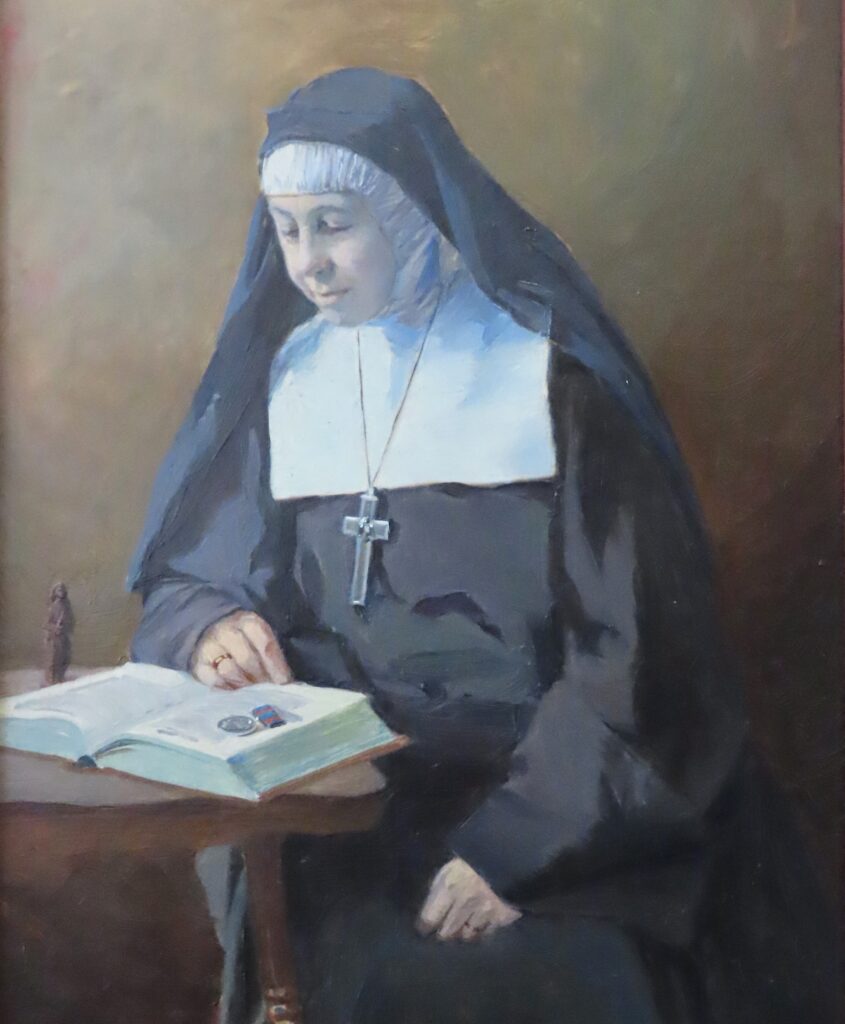
And I came to understand myself better, the more I came to know about Mother Hannah, the more I deepened my own knowledge of Jesus and the little community of disciples he formed, and the more I came to understand more of St. Benedict and his sixth-century Rule for monasteries. Our own Rule of Life, which Mother Hannah first drafted in 1883, was based on that ancient and yet contemporary Rule of Benedict, with its emphasis on balancing the contemplative and active life. I have come to know that it is the intention to balance the poles of our human life which is the heart of the challenge of Christian community. Not succeeding but intending and trying.
Life in community is a rhythm between work and rest, prayer and service, and eventually you discover that service is also prayer and rest can be work – the work of self-care as well as other-care.
What is most important, though, and what is essential in living this rhythmic balance is obedience. For Mother Hanna, Benedict, and Jesus, obedience is what meaningful life is all about. Obedience not in the sense of following orders but in the sense of loving attentiveness and deep listening and response.
The readings this morning illustrate beautifully what this kind obedience means.
In the book of Deuteronomy, we have the challenging and inviting expression of what it means to be obedient:
Hear, O Israel: The Lord is our God, the Lord alone. You shall love the Lord your God with all your heart and with all your soul and with all your might. Keep these words that I am commanding you today in your heart.
The commandment is to love. Obedience to God is to love. To love is obedience.
In the gospel this morning Jesus, as he is walking through the vineyard with his disciples shortly before his death, says:
As the Father has loved me, so I have loved you; abide in my love. If you keep my commandments, you will abide in my love, just as I have kept my Father’s commandments and abide in his love. I have said these things to you so that my joy may be in you and that your joy may be complete. This is my commandment, that you love one another as I have loved you.
Jesus’ words here seem a little circular – and they are, because it’s all very simple even if difficult. Abide in my love – a simple but not easy commandment. The way to do it, Jesus says, is to abide in my love. And If you keep my commandments, Jesus says, you will abide in my love. My commandment is that you love one another.
That’s it. My commandment is to love. Period. End of story. Love.
That is ultimately what religious communities are about and what Hannah tried to help her sisters grow into. We try to live a life that can be a model of Christian community. And we fail. That’s the thing. Community is about failure, not success. It’s about learning to accept ourselves and our sisters with all our imperfections and sin. Outside community we can run away. Inside we cannot.
The single word “Love” in English means many different things, but life together means learning to deepen the meaning of that love. It is sacrificial. It means we can only love when we fail, when we come face-to-face with our own vulnerability and don’t run away. Knowing our own sinfulness and vulnerability, we learn to love more deeply.
And because each of us has a personal as well as a communal relationship with God, that one word love comes to mean receiving as well as giving. When Jesus reminds us to love, he means not only making room for the others in our life who may not be so easy to love, he also means that we need to allow God to love us.
In Paul’s letter to the Ephesians, he prays for this deep intimacy with God – the commandment is to receive love as well as to give it, and the two are inseparable in community life.
For this reason I bow my knees before the Father, from whom every family in heaven and on earth takes its name. I pray that, according to the riches of his glory, he may grant that you may be strengthened in your inner being with power through his Spirit and that Christ may dwell in your hearts through faith, as you are being rooted and grounded in love. I pray that you may have the power to comprehend, with all the saints, what is the breadth and length and height and depth and to know the love of Christ that surpasses knowledge, so that you may be filled with all the fullness of God.
All of these dimensions of love and obedience have come together in my life to show me that it is not whether I follow strict orders or live a perfect life that makes life in community worthwhile. It’s when I recognize my own creatureliness that I get glimpses of the divine in my community life.
There’s a poem by the contemporary poem by the Irish poet Padraig o Tuama which illustrates this. It’s a deeply felt and profoundly loving expression of Mother Hannah’s legacy as well as the three scripture verses this morning. It’s called “The Facts of Life”:
That you were born
and you will die.
That you will sometimes love enough
and sometimes not.
That you will lie
if only to yourself.
That you will get tired.
That you will learn most from the situations
you did not choose.
That there will be some things that move you
more than you can say.
That you will live
that you must be loved.
That you will avoid questions most urgently in need of your attention.
That you began as the fusion of a sperm and an egg
of two people who once were strangers
and may well still be.
That life isn’t fair.
That life is sometimes good
and sometimes better than good.
That life is often not so good. That life is real
and if you can survive it, well,
survive it well
with love
and art
and meaning given
where meaning’s scarce.
That you will learn to live with regret.
That you will learn to live with respect.
That the structures that constrict you
may not be permanently constraining.
That you will probably be okay.
That you must accept change
before you die
but you will die anyway.
So you might as well live
and you might as well love.
You might as well love.
You might as well love.
Poem credit Pádraig Ó Tuama.