By The Rev. Canon Joanne Davies, Oblate, SSJD
My first-born child came into the world in the early dark snowy hours of January 23rd, 1984. Kate Alexandra. She was beautiful. And more alert than I could ever have imagined. I immediately felt like she was going to lead me into a new life. Kate would quiet when held, as long as she could hold someone in focus, someone she decided would be there to care for her with long intention. She had little patience for the nurses or any of the other babies in the nursery. Though it was not common practice then, the nurses had me keep Kate in my room as she disturbed every other child there. She did not like to be swaddled. She would push her arms and legs against the professional swaddling of the nurses and was not to be comforted till she was free. I’d hold her closely but unswaddled, as she calmed, feeling her embodied soul against me. Outside of me now, and yet more with me. I would feel like there were words spoken into my soul in these moments. Words of wisdom and change and hope entering my life, telling me to get a move on …begin a new healthy life, encouraging me into a difficult but new path. My marriage was abusive. Kate’s presence gave me the ability to stop spiritually bypassing everything I was feeling. She needed safety and so I must find safety for myself. I knew it would be hard, a journey full of struggle and pain and need but one filled with the strength and light of love. Babies are light, bringing Love, because they need Love and also gift Love. Bringing love to light the way to help us see. Not with a loud brilliance, but with the shimmering of a candle making the darkness glow. Like tears. Joy and sorrow.
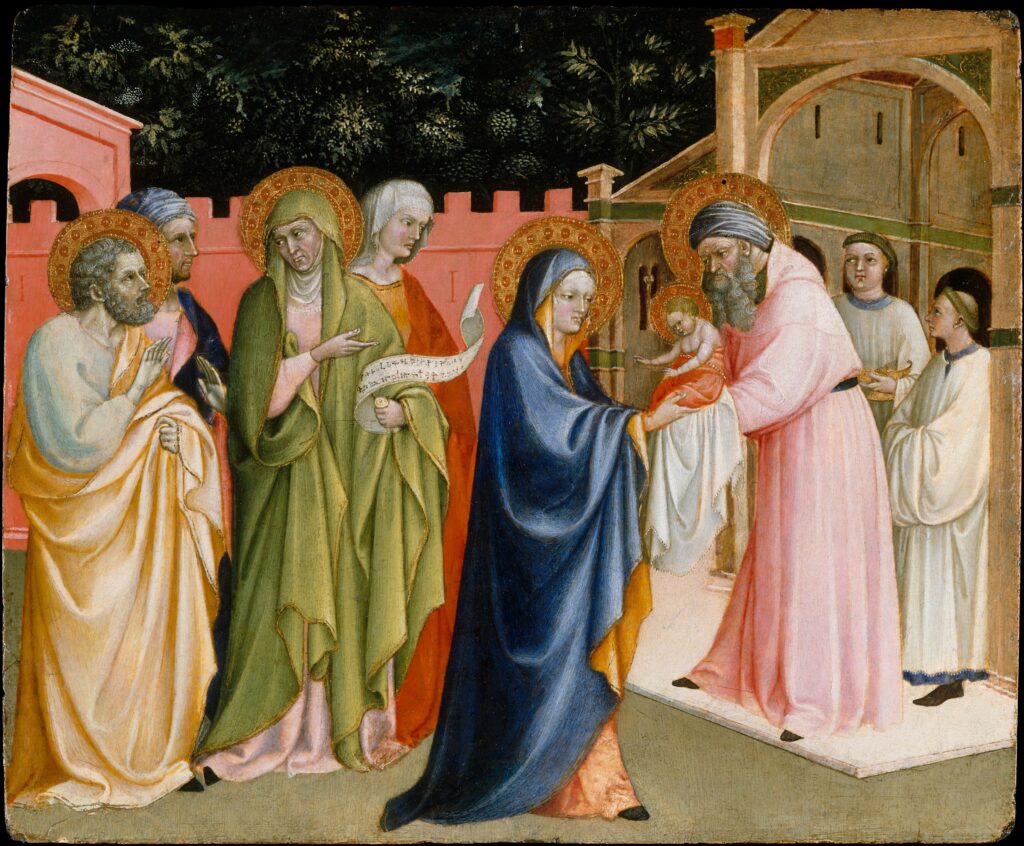
Imagine Joseph and Mary and their baby and the words of Angels already spoken into their souls. But here they are in their earthly life having to fulfill what is required them for their baby. They were poor and days must have been achingly worrying and exhausting but still they responded with love in their praise of all the hope God had brought them. They responded with a deep desire to nurture their baby’s life for the life of the world.
I see them a little tired and uncertain as they come into the presence of Simeon and Anna.
Neither Simeon nor Anna, lived an easy life. There is a tiredness in Simeon’s words after he takes the baby Jesus in his arms: “Now, Master, you may let your servant go in peace.” Simeon had received a special revelation that he would not see death before he had seen the Messiah, and his words hint that it might not have been easy to hang on until that moment. I know many people who held to life to be present at a special occasion for a loved one or for the birth of a child in the family. There is something of a letting go alongside gratitude in Simeon’s words.
But Simeon still has something to give. His prophecy to Mary would stay with her in the decades ahead. To the blessing he received, Simeon responded with a blessing.
This is about what just a glance of God’s glory means for Simeon. After all, he sees the Messiah only as a baby. He will never hear the Sermon on the Mount, see Jesus cure the sick or raise Lazarus; and, though his words to Mary allude to the crucifixion, he himself will not be there. His eyes do see the salvation God has prepared in the sight of all the peoples—because salvation is Jesus Christ—but only just barely. And that is enough. Jesus, before he can speak, before he can walk—but present—is enough. Simeon has lived his life in hope for the moment that we see in the Gospel, and yet that hope fulfilled is itself a promise of more to come. He is led from hope into hope.
We do not hear any of Anna’s words. Anna’s actions speak. We can infer that she has suffered much, and she has suffered patiently. She has had more than half a century of widowhood. We do not know if she had children, but either way, childless or raising children alone, Anna would not have had it easy. We do not know the turns her spiritual journey may have taken, through loss and aloneness but we do know that somehow she was able to turn her suffering into worship. Her life itself became worship. “She never left the temple,” we are told.
In her prayer Anna recognizes Jesus as the one who would bring “the redemption of Jerusalem” and comes forward to see the baby. And that brief encounter changes her life, and she becomes a person sharing hope with others in the world.
We see human life at its fragile extremes—at the beginning and near the end—and we see that the presence of God can transform those frail limits into moments of transcendence that give everything before and after meaning.
Simeon and Anna are faithful to the traditions of their people Israel, devoted to the worship of God in the Temple as commanded.They trust the promises, the promise we heard from the prophet Malachi: and the Lord whom you seek will suddenly come to his temple. They may not know the plan, but they know enough to recognize Jesus when he arrives. There is persevering and surviving in their hope.
And realism. Simeon acknowledges the opposition Jesus will face, the pain that Mary will undergo: “You yourself a sword will pierce.” And yet none of that adversity—past or future—diminishes the wonder of the gift; the wonder of a child, a baby in whom redemption is made present; the promise of a new life to come. Nothing diminishes their wonder or gratitude or joy at a hope fulfilled and a new hope revealed
Stephen Reynolds says in celebrating this feast of the presentation we become like Simeon who cradled the infant Light of Salvation in the crook of his arm and knew him to be as fragile as a candle-flame. In baptism, in meditating upon Scripture, and in the eucharist, Christians cradle the same Light and take responsibility for the life of Christ in our world. And yet, even as we hold Christ in our hands, we may discover we are really in the crook of Christ’s arms, being presented by him in the sanctuary of God’s joy and glory.