By The Rev. Frances Drolet-Smith, Oblate, SSJD
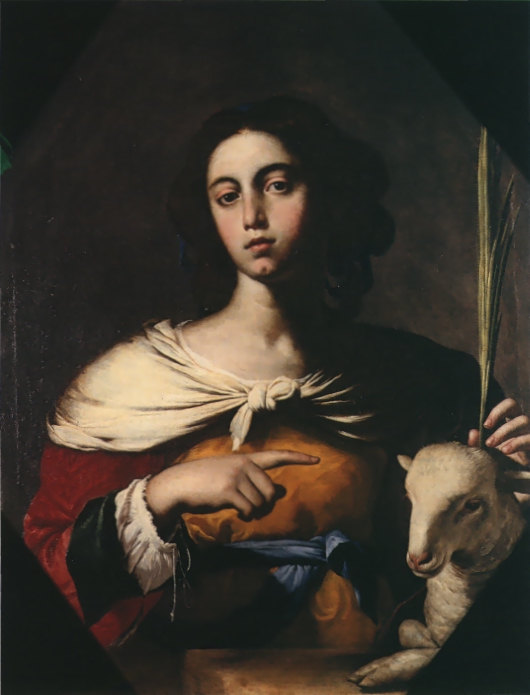
Today we’ve come to remember St. Agnes of Rome, martyred for her faith in 304 CE, when Diocletian was Emperor. Persecution of Christians was common then. Agnes had been born into the Roman aristocracy around the year 291, and so was about 13 when a governor’s son sought to marry her. Agnes, who was raised a Christian, rejected him declaring “Jesus is my only Spouse”. Her suitor, seeking to punish her, brought her before the magistrate. When Agnes refused to renounce her God, she was dragged naked through the streets, and subsequently sentenced to death. Some sources say she was ordered to be burned at the stake, while others say she was to be beheaded. Stephen Reynolds notes: “What truly matters to the Church is not the manner of her death, but the maturity of faith displayed in so young a child.” She spoke truth to power with courage – and conviction, trusting the One whom she loved.
The scriptures appointed for this commemoration make for poignant reading, especially as we mark this remembrance in these times in which we are living.
For most of us, in the edition of the Bible that many of us regularly use, the book of Esther has only 10 chapters. The portion we’re reading today, from chapter 13, is actually in the deuterocanonical books of the Bible, sometimes called the Greek/Apocrypha. These are “extra” books, not included in the original Canon of the Scriptures. The few verses we heard are known as “Mordecai’s Prayer” in which he assures God that he remembers all that God has done for him and for God’s people. Now, to give some context, in chapter 3, Mordecai is ordered to bow to Haman, a local authority and Mordecai refuses but does not say why. In fact in the first 10 chapters of the book, God is not mentioned by name, and though Mordecai does identify himself as a Jew, neither his faith nor that of Esther is explored. It isn’t until chapter 13, in midst of his prayer, that Mordecai explains why he refused: it was because he only bows or pays homage to his God for God has been good to him and to the people. In his own way, by his resistance, Mordecai spoke truth to power with courage – and conviction, trusting the One whom he loved.
In the portion from Matthew’s Gospel, we hear Jesus warning his followers of the cost of discipleship: “you will be handed over to the local councils and be flogged in the synagogues.On my account you will be brought before governors and kings as witnesses to them and to the Gentiles.” He then goes bluntly on, describing the extent of the cost to intimate, familial relationships his followers may be asked to bear. In their own way, the followers of Jesus were each called upon to speak truth to power with courage – and conviction, trusting the One whom they loved.
Some eighty years after Agnes’ death, Ambrose of Milan wrote: “Everyone marvelled that Agnes was so spendthrift with her life, which she had hardly tasted, but was now giving up as though she had finished with it. All were astounded that she should come forward as a witness to God when she was still too young to be her own mistress. So she succeeded in convincing others of her testimony about God, though her testimony in human affairs could not yet be accepted. The onlookers believed that she had received from God what could not come from humans; for what is beyond the power of nature must come from its Creator.”
On January 9, in Concord, New Hampshire, a vigil was held for Renee Nicole Good, a woman shot 3 days earlier by immigration agents in Minneapolis. The local Episcopal bishop of NH, Robert Hirschfeld, urged his clergy to “finalize their wills and get their affairs in order to prepare for a new era of martyrdom”. As you can imagine, the bishop’s stark warning to his clergy is resonating across the nation, drawing fervent praise from some and angry rebukes from others. In an interview following his pastoral statement, the bishop clarified his actions saying he had done so, “because it may be that now is no longer the time for statements, but for us with our bodies to stand between the powers of this world and the most vulnerable.”
You and I may never be called upon to speak truth to power in such dire, drastic, dangerous situations, but regardless, our following Christ demands we live each moment, enter each conversation and every room with courage – and conviction, trusting the One whom we love, in the same way Agnes, Mordecai, and those other early followers of Christ did before us. For such is the cost of discipleship, the price of faithfulness.