By The Rev. Canon Joanne Davies, Oblate, SSJD
“…who hears these words of mine and acts on them will be like a wise man who built his house on rock. The rain fell, the floods came, and the winds blew and beat on that house, but it did not fall, because it had been founded on rock.”
– Gospel of Matthew
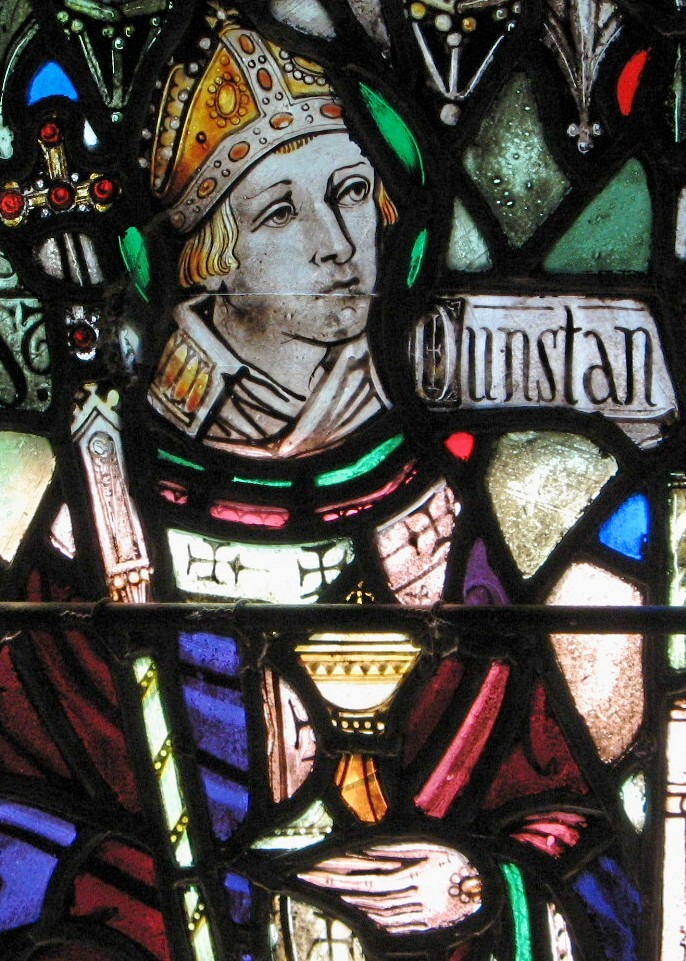
Today belongs to St. Dunstan of Canterbury. Born about the year 909, near Baltonsborough in Somerset, the son of a nobleman, Dunstan was educated by Irish monks and visitors at Glastonbury abbey.
From an early age, Dunstan displayed both a sharp intelligence and artistic gifts. He was skilled in music, manuscript illumination, metalworking, and scholarship. In his medieval monastic culture, the pursuit of beauty and craftsmanship was his offering to God.
In the year 943 King Edmund made Dunstan the abbot of Glastonbury. The abbey needed rebuilding and Dunstan set about that with enthusiasm. Dunstan also instituted the Rule of St. Benedict with the monks, re-established the enclosure, and a greater enrichment of crafts and music to the life of the Abbey. Lighting a sharing in the glory of God. Through Dunstan’s encouraging leadership the abbey established a famous school for the local youth. The abbey also made beer as one of their crafts. An annoying rival, if you will, to the popular, almost mythical cider, of Somerset, which probably accounts for the local tales of Dunstan mixing with the devil to bring Spring frost to the apple trees.
A new king, King Eadred, made Dunstan the chief minister of state. In this capacity Dunstan sought to establish royal authority, to conciliate the Danish section of the kingdom, to evangelize, and to bring new life to the church.
Some stories say that Dunstan eventually quarreled with the king. Either way, Dunstan was sent out to Flanders to the abbey of Blandinium. Dunstan did not identify as a banished person. He chose to explore and learn all the best of monasticism there. On his return to England, Dunstan applied his learning to healthily restructure English monasticism. King Edgar made him bishop of Worcester and London. In 959 Edgar became sole king of the English, and Dunstan was appointed archbishop of Canterbury, bringing his encouragement to a period when intellectual activity flourished in England.
His years as archbishop were marked by energetic pastoral leadership and institutional reform. He worked to improve clerical discipline, encourage education, support monasteries, and promote greater liturgical unity throughout the kingdom. Within the monasteries, Dunstan encouraged monks to live in a spirit of self-sacrifice and forbade simony (the selling of church positions for money). He often replaced secular canons with monks in the cathedrals and ensured that parish priests were qualified for their positions. He wanted the faith-filled discipline of life to clearly truthfully point toward Christ.
Dunstan’s legacy includes founding Westminster Abbey. Not the grand structure of today … that did not arise until the 13th Century. But… While a small church had already been present on Thorney Island, west of the City of London, at the beginning of his time as Archbishop of Canterbury, Dunstan commissioned twelve Benedictine monks to establish a new, permanent monastic community there. It became known as the West Minster. The former island is now, after centuries of development, part of London’s City of Westminster.
On Edgar’s death, in 975, Dunstan secured the crown for Edgar’s elder son, later known as St. Edward the Martyr. After Edward was murdered in 978 Dunstan’s public career slowed, and turned to found a stability and comfort and, by all accounts, peace in Canterbury, where he taught at the cathedral school.
In the end, Dunstan was far more than a church administrator; his leadership flowed from the deep Benedictine spirituality that formed his early life and ministry. Even while advising kings and navigating political crises, he remained fundamentally shaped by prayer, contemplation, and the rhythms of the religious life.
So much to teach about life. Such a journey he had. His wisdom was built on the rock of his faith.
Dunstan died on May 19, 988. It is often said that in the later years of his life he was given the gift of visions and miraculous powers. Whatever the shape of truth in these stories, I imagine that after the loving labours of his life he found himself closer to the divine within and around him. And closer to the divine in all ordinary life – so that the miracles and interconnectedness of heaven, of the world, and all the universe, were revealed in his heart and presence. Humility midst awe.