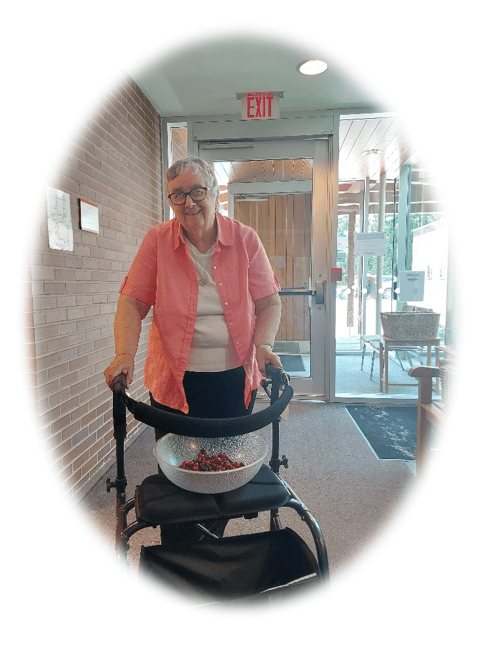
By Sister Doreen, SSJD
(Genesis 12:1-3) “Now the Lord said to Abram, ‘Go from your country and your kindred and your father’s house to the land that I will show you. I will make of you a great nation, and I will bless you, and make your name great, so that you will be a blessing. I will bless those who bless you, and the one who curses you I will curse; and in you all families will be blessed’.”
It is worthwhile for us in our own spiritual journeys to remember that both Abraham and Sarah were very senior citizens when this call came to uproot themselves and go to a place they never heard of before. They must have found it extremely difficult to make a change at that point in their lives. But they heard the call and obeyed God’s word and set out!
Abraham and Sarah’s story recalled something that Richard Rohr said: “We do not find our real purpose until we feel a certain sense of a loss of control, and that is what opens us to growth in the second half of life.”
For so many of us who are journeying into the second half of life, or for those who are well into those years as senior citizens there have been changes – we are like Abraham and Sarah, and their story becomes our story. We like them are called to uproot ourselves and go to places we probably have never heard of before or experienced before. It is an extremely difficult time, and the often-repeated phrase “growing old isn’t for sissies” rings loud for most of us. It often feels like becoming an isolated minority, somewhat sidelined from mainstream society. A move into an experience of retirement, most of us have lost loved ones, children and grandchildren often live far away, we worry about choices that our families make, we even begin the loss of diminished abilities and health, and we forget things.
One of the most painful experiences once well into retirement and the senior years, seems to be a loss of esteem in the ways we are frequently talked down to or handled with a kind of remote care. In a market-driven society, we are no longer ‘useful’. It is hard to let go, to seem redundant, to be put on the shelf, to not be able to do the things that we used to do. There is a longing to be understood for there’s more to us than meets the eye: more dreams and desires and passions, more memories, fun and cleverness, more intelligence. Increasing limitations due to aging catch up with us, and yet still we have dreams and desires and passions, and memories, and laughter and joy – and wisdom intelligence! We long for others and the world around us to remember however that we are part of a long generational continuum! As Margaret Silf writes in her book “The Wisdom Years”: “Every generation builds on the wisdom and experience of those who have gone before. We all benefit from the inventiveness, creativity, courage, and generosity of our ancestors.” It often doesn’t feel like this is important any more in our consumer, competitive society..
Like Abraham and Sarah, we have been called to a foreign land and have made or are making a difficult journey. As I pondered old age, I thought yes, along the way we have lost some things, but we have also gained some things: life and love and adventure and achievement, and most of all we have journeyed with the promise: “I will be with you, I will be your God and you will be my people – God’s covenant with us to never leave us nor forsake us, God’s promise of an unconditional, tenacious love that will not let us go. We have laughed and cried on our journey while we have confronted challenge and change. And we have come to know in a deeper way that we are God’s chosen people! What opens up for us is a new opportunity for growth, a deep inner growth in this second half of life.
We are learning that “In the second half of life, it is good just to be a part of the general dance. We do not have to stand out, make defining moves, or be better than anyone else on the dance floor. Life is more participatory than assertive, and there is no need for strong or further self-definition.” —Richard Rohr.
It is the participatory word that stood out for me as I pondered this second half of life. It’s an important time for sharing, for that hands-on experience – perhaps one of the most important gifts that the second half of life can offer to the world today. As Margaret Silf puts it in her book: “We can’t give the next generation a roadmap for their onward journey because the map we used ourselves doesn’t cover their future terrain. What we can pass on are the values that we feel have guided us along the way (not the creeds and doctrines). Values are best passed on by living them ourselves in ways made visible in our behaviour towards others and the way we make our choices.”
It is so important that we share our life stories with others, share our hopes and dreams, our passions and our hurts, our deepest desires and our wisdom and memories. We each need to know how important that this is, especially in a world that today is so media oriented, with a deficit on the importance of an inner life. We need to hear words so often spoken by others – “don’t ever save anything for a special occasion. Every day you are alive is a special occasion”. Often it is the little things that are most important: time to stop and stare, to ponder, time to linger over a cup a tea while watching the sunset, reading a book, spending more time with family and friends, less time in meetings and busyness. The second half of life offers more opportunities for reflection and contemplation, for living more deeply into the paradoxes and contradictions of life – time to seek deeper understanding.
As we have journeyed into our senior years, we have probably acquired a certain wisdom that helps us see beyond the social pressures and conventions of daily life. There is a gradual acceptance of aging and its limitations, as well as its freedoms. We arrive at a place where we can be ourselves – have even a bit of wildness about ourselves – our own creativity, of being answerable only to ourselves and God. We come to arrive at a place where we should be able and ready to say and do things that we want to do, to break a bit out of our old molds and have a unique flair, glamour, and dash! It is choice and often a difficult choice – to choose to be who I am amid the surrounding pressures for performance, and value, keeping up the good looks! What we do discover is that our faith has not been for overcoming obstacles; it has been for experiencing them — all the way through! It is a richer, deeper, and freeing experience to discover in new ways our ‘real’ self. It is a time when we can acknowledge that the ‘social tyrants of life’ will come and go but we become aware in the second half of life that ultimately, we are answerable only to ourselves and God!
Our journey into the spirituality of aging also moves us into a time of repairing. Joan Chittister in her book “For Everything A Season” writes: “there is a time in every person’s life when the process of being healed, of coming beyond my own woundedness, may itself be life’s greatest project.” She goes on to say that we all need this, we all need to go through this in order to be whole, to take the time to do some deep self care and make ‘friends’ with those areas in our lives where we have left undone things that need to be done and healed, to find new joy for ourselves, to find new ideas in which to live, to trust ourselves with others. Richard Rohr calls this Falling Upwards! The process of taking what has seemed broken and lifting it upwards into the light and love of God. We have the opportunities in the second half of life to take the time to come to new levels of compassion and to our own personal value, and to new understandings of forgiveness.
There are times also, and I am sure that Abraham and Sarah had these moments, times when we have a sense of gloom or hopelessness, wondering why it has taken us so long come to ‘see’, really ‘see’, to turn to God! For so many years it seemed that God and the spiritual life were always left on the back burner! Such was the busyness of life, the managing of all that our growing years called us to. Now as I age and think about my life I remember poems like “The Hound of Heaven” which ends with the words from God “Ah, fondest, blindest, weakest, I am He Whom thou seekest!” and St. Augustine’s prayer: “Late have I loved thee, O Beauty so ancient and so new; Late have I loved thee … I sought thee outside and thou wert with me and I was not with Thee.” We are dealing with a God who has been watching us, who has been pursuing us, for a !lifetime. Why has it taken us so long to ‘see’ this?!
Our experiences, like Abraham and Sarah’s, as we journey into the second half of life, were to discover a humble inner knowing. Life in all its ups and downs becomes the great spiritual teacher. The unsatisfactoriness of human existence creates in us a kind of spiritual homesickness. We become aware that this incompleteness, this longing, is built into our lives – we wait, we long for more, and we were made for and called always to more and more of that understanding that we are held in the infinite embrace of a loving God who patiently and passionately waits for us. Always and everywhere, at all times and places, we are people, like Abraham and Sarah, of the covenant, whom God has called by name and from whom God has never been absent. Even though hidden at times, God loves us with an everlasting love. It is such a gift this humble inner knowing, a mystery that can only be held in grateful hands and hearts.
As the Abrahams and Sarahs of our age and time, we know that we have to continue to leave what we know for what we do not know. Yet this God has never and will never abandon us. As we stand now in this second half of life in our spiritual journey, a poem of Leonard Cohen comes to mind: “Ring the bells that still can ring, forget your perfect offering. There is a crack in everything, that’s how the light gets in.” I know that as I think of myself, I am pretty well cracked, and a whole lot more ackey! But then with a smile, I think of all the light those cracks have let into my life – of, hopefully the light that has also shone out of me, and of that great Light that awaits me when my journey is ended.
I end with a hymn from Common Praise, Anglican Church of Canada #468 “To Abraham and Sarah”:
To Abraham and Sarah, the call of God was clear: ‘Go forth and I will show you a country rich and fair.
You need not fear the journey, for I have pledged my word that you shall be my people
and I will be your God.From Abraham and Sarah arose a pilgrim race, dependent for their journey on God’s abundant grace;
And in their heart was written by God this saving word, ‘that you shall be my people
and I will be your God.We of this generation on whom God’s hand is laid can journey to the future secure and unafraid,
Rejoicing in God’s goodness and trusting in this word, ‘that you shall be my people
and I will be your God.
Yes! Yes! “Arise shine for your light has come, and the glory of the Lord is risen upon you.” Isaiah 60:1.