By Sr. Constance Joanna, SSJD
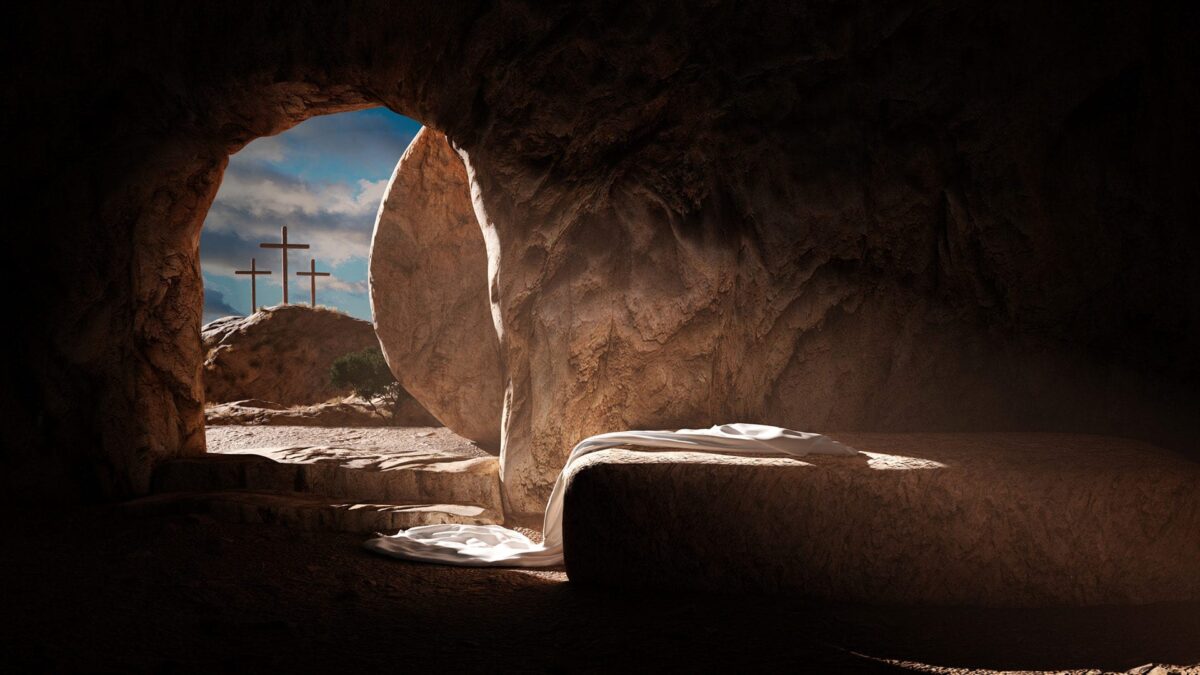
I’ve been sitting with John’s version of the resurrection story for a few days now, in a stance of lectio divina as I accompanied Jesus’ friends in the few brief lines we have in today’s gospel. For some reason I can’t explain, I started viewing it sketched out, as in a graphic novel. Imagine the first frame. It’s a still-almost-dark night with a young woman seen from the back, longish hair spilling out from under a shadowy cloak, moving tentatively, almost furtively, toward an unknown destination, just a tiny bit of moonlight illuminating her steps. In the next few frames the sky lightens slowly but steadily, until we see ahead of her something that looks like a cave – no, it’s a tomb and it looks as if someone has opened the tomb because the stone that would normally cover the opening was off to the side.
The young woman, whom we can now begin to see in profile, looks expectant, but in the next frame fearful as she stops suddenly. Without approaching any closer, she turns and starts to hurry back in the direction she came. In the next few frames she is running, crying, breathless.
Then we see her arriving at a humble dwelling, banging on the door, which is opened by two young men. We see them listening intently to the words enclosed in the call-out bubble – “They have taken the Lord out of the tomb, and we do not know where they have laid him” – she speaks loudly, indicated by capital letters and exclamation marks. The men say nothing, but look at one another, then start running in the direction from which she just came. A bystander would wonder what the excitement and haste was about. Unlike Mary, who walked tentatively toward the tomb earlier, the two young men run as fast as they can, their anxiety arisen as they try to comprehend what has happened – an anxiety shown by the looks on their faces. The graphic artist has put a few words in the call-outs – “Peter, hurry,” “John, wait, I can’t keep up,” “Mary what does this mean?” It’s a race – John arrives at the tomb seconds before Peter. We see him come to a sudden halt, look at some graveclothes lying at the entrance, clearly not computing what has happened. Peter passes him and runs right into the tomb, and he too sees the graveclothes along with the other detail of the headdress lying separate. He looks as startled as Mary when she first saw the tomb wide open.
A pause – maybe an empty frame with a big question mark – then John runs in, stares as what he sees, clearly trying to make sense of it, and the call-out in the last frame, “He saw and believed.”
There the graphic story ends. The reader is left to imagine what has happened and what might follow. He saw and believed. What did he see? What did he believe?
This short sequence of the resurrection story takes me right into the graveyard, showing us the frightened, startled, grief-stricken, then joyous friends of Jesus. But as well as I know the story, that last frame brings me up short. What did John see? What did he believe? What do you see? What do you believe?
I’ll sketch out another graphic strip. There’s a simple, light-filled chapel with choir chairs arranged as in a mini-Cathedral. There are a lot of people in those seats, and from the muted colours of their hair you might guess they were mostly older rather than younger. Here and there is a walker or cane. Some are dressed in similar blue dresses, others in a variety of colours and patterns. The women look relaxed, expectant, waiting for something. In the next frame they are standing, holding books in their hands, and in the call-outs above their heads are music notes. They are smiling, clearly enjoying whatever it is they are singing. In the next frame they are sitting, in a listening posture. Then a frame with a woman in vestments behind the altar, with bangs and a long dark ponytail, holding out her arms in a warm, welcoming, smiling stance. Another frame – that woman and two others in blue are standing in the aisle, offering food and drink to people lined up. I see myself in the line-up now – the woman holds out a piece of bread to me and the call-out bubble reads “bread for your journey.” A few more frames – people singing again, standing, sitting, and the call-out in the final frame, “Go in peace to love and serve the Lord” with bubbles above the heads of each person in the seats, rather like the Pentecostal flames, saying “Thanks be to God.”
That’s what I saw when I was in the tomb with John. And what did I believe? That Jesus’ resurrection was not a disappearance, but a transformation – not only of Jesus but of his friends and his mother, and of all of us who have been his friends from age to age. I saw that beautiful group of women in that lovely light-filled church transformed into a force of prayer and service –a community of Oblates attending their triennial conference, with sisters – priests and lay, older and younger, in habit and in all manner of dress. Together in prayer, together in spirit as each in their places is learning to become the hands and feet of Jesus.
Looking back at that tomb – it was empty. There was no need for it any longer. And there is no need of the grave of despair and sadness in which we so often enclose ourselves. Woe is me, but I’m getting so old. Woe is me, I have no energy. Woe is me, my community is shrinking.
But there was no woe for Jesus, only blessing. He left the tomb and in doing so showed his friends and disciples that they had everything they needed to love him and serve him. They had one another. They would soon have the Spirit. The disciples had no clue what was in store for them, no vision of a future. They started in grief, but as fast as Mary turned around and ran in the other direction, their sorrow turned into joy. A joy that had no idea, yet, of a future. Only that they were now called to be Jesus for one another and for the world.
In the first letter of John, we hear “This is the message we have heard from him and proclaim to you, that God is light and in him there is no darkness at all.” The future is unknown. Clear-sighted John, the Eagle-eye, could not see the future – he could only see the light, the way forward. What is the way forward for us? To walk together, letting each leg of our journey reveal the next – just like the lighting system in our renovated Guest House – as you walk into a room, the light turns on. We need only, together, to walk into the future – Oblates and Sisters with the rest of the extended SSJD family – Associates, friends, supporters, guests, staff, volunteers – walk into it with confidence, and together, knowing the light will turn on, step by step, as we walk into the darkness. For me, the film we watched last night (Peace by Chocolate) is a perfect metaphor for St. John’s vision. In the very opening scenes, the focus is on Tareq’s large, beautiful eyes, moving from side to side, and those eyes become a lens through which we see the future after the devastation his family experienced. Like John and the disciples after the resurrection, like us in a time of great change in the church and monastic life, Tareq and his family simply walk out of death into the light of a new life. May we do