By Archbishop Linda Nicholls
The older I get the simpler the gospel becomes. The things that seemed so important about living as a Christian and trying to get it ‘right’ become less significant. The arguments over the right way to do liturgy, chairs or pews or purity of moral actions increasingly become less important as they are reduced and literally boiled down to one word – LOVE.
If you knew you were going to die in the next twenty-four hours – or at least there was a good chance that would happen – what would you want to do or say to those most important to you? There were many, many stories of phone calls from those caught in the twin towers on 9/11 who knew they would not make it out alive, phoning their spouses and children with messages of love. A couple of weeks ago a number of ice fishers were caught when the ice they were on detached from the shore and began drifting into Georgian Bay. Despite running to find a way off they soon realized they could not and that help might not reach them in time as the ice began to break up. They too phoned families with messages – ‘Tell the kids, I love them”. Love supersedes all else.
Whether Jesus knew exactly what was going to happen or not in the next twenty-four hours, he knew the tensions were extreme and he was a target for religious and political concerns. After three years with the disciples what message could he leave with them that was direct, simple to recall and would carry them through whatever lay ahead? What did they need? What signs would they remember?
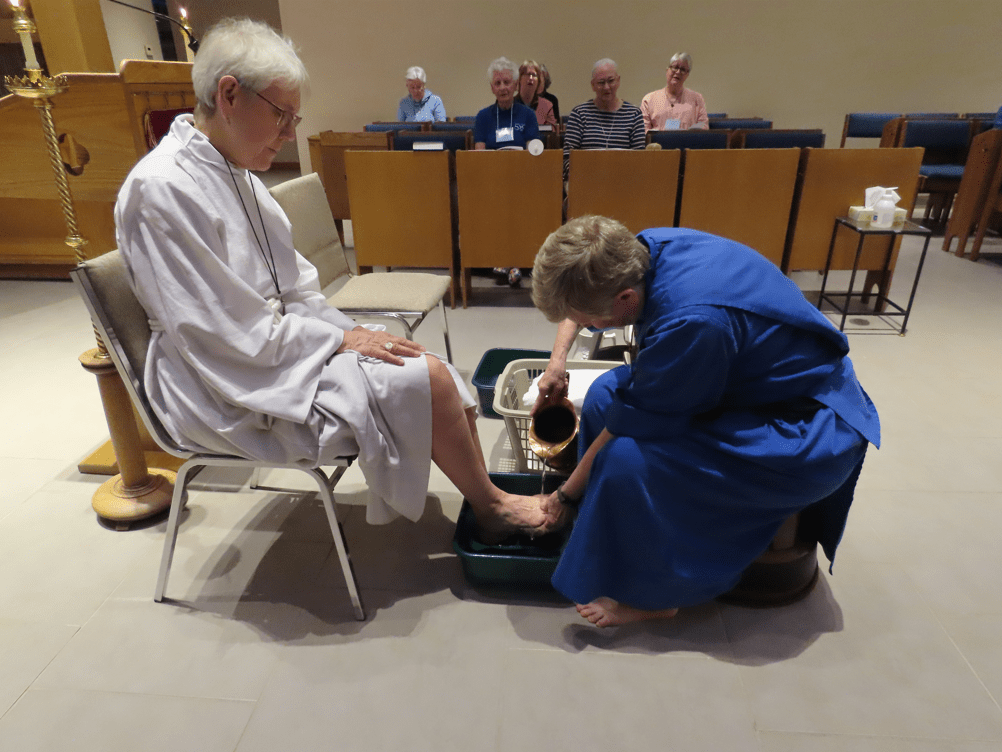
Often in the midst of an important meal the host will clink a glass and call for the attention of those present. This will be the moment for an important speech or announcement. Jesus, in the middle of this meal, stands up and, without words, puts on the clothing of a servant – and washes their feet. What a shocking disruption of expectations. Their teacher, master, beloved – is doing what no one else had thought to do – an action reserved for a slave or servant.
Then he speaks…..
“A new commandment I give to you – Love one another as I have loved you.” The command to love is hardly a new one. It is at the core of the Torah – Love God and Love neighbour as self (Leviticus 19:18) and repeated by Jesus when questioned by a lawyer and a scribe. Yet here John recalls Jesus adds something new to the command – Love as I have loved you.
Experience is our best teacher. You only touch a hot stove once and know not to do that again! When we have received a generous gift we want to pay it forward. The disciples had experienced what Jesus’ love looked like. Over and over they had seen him reach out to those others rejected offering healing, respect, dignity, kindness and welcome. Matthew, Zacchias, the Samaritan woman, the blind man, the lepers. Now in this critical hour he has washed their feet – all of them, Judas included. He noticed a need and met it without any expectations. We can imagine their confusion. Leaders do not act as servants. But Peter catches the spirit of the moment and enthusiastically asks for more! Always the impetuous one!
Jesus shares how they are to receive what he has done. “Just as I have done to you – you are to do for one another.” And goes on to teach them how they are to show the world what love looks like by how they love one another. Love as I have loved you.
Jesus will then go on to show them the ultimate act of love in his death. At his arrest he will refuse the temptation to violence. He will not call for insurrection or revolution. He will surrender himself to God and trust.
It sounds simple – love on another. Why then is it so hard to do? Christians are not known for our love for one another – rather for our ability to hate one another, verbally attack, and divide ourselves believe we are the pure, right ones. Our own beloved Anglican Communion lives in the midst of verbal warfare over who is truly righteous – when actually none of us are.
Love requires the humility of servanthood, willing to offer oneself to the other for their wellbeing. Love requires offering that service to all – not just the ones we like or the ones who are like us or the ones who follow the rules – but all, as beloved children of God – respecting the dignity of every human being. Love sees the pain of others alongside one’s own – both intertwined – both needing healing – and does not judge.
To love as Jesus loved us invites us into self-examination – whose feet would I not wash? Who do I not long to see whole and healed? It invites us to suspend the assumptions we make about others; the judgements we so quickly jump to…..and learn an inner attitude of openness and curiosity that is willing to give before receiving.
Every year we return to the sign of the washing of feet to strip away our pretensions and hear again the primary call to love as Jesus loves us. Tonight we feel and experience the washing of feet and we come to the table to receive his body in blood, the ultimate signs of that gift of love.
I love the questions used in Gospel Based Discipleship. After reading a passage of scripture and first asking. “What phrase or word stands out?” And then asking: “What is Jesus saying to you?” The third question asks, ‘What is Jesus asking you to do?’
For me, this Maundy Thursday – the answer to the first – is ‘Love one another as I have loved you.’ The response to the second is, ‘Jesus asks me – Who do you not love?’ And the third is – Jesus is inviting me to set aside what is not important and love first, before judgement, before rules – see others as the children of God they are – beloved in God.
So as we hear Jesus and are commanded to love one another as I have loved you, we are called to self-examination. We are called to ask ourselves, ‘whose feet would I not want to wash and who am I called to reach out to in love among those around me among those in my community, those in the world? Who is it that needs to feel the healing grace, touch of Jesus in their lives and their world?
Tonight as we contemplate Jesus’ acts of servanthood and love – what is Jesus saying to you? What is Jesus calling you to do?