By The Rev. Canon Joanne Davies, Oblate, SSJD
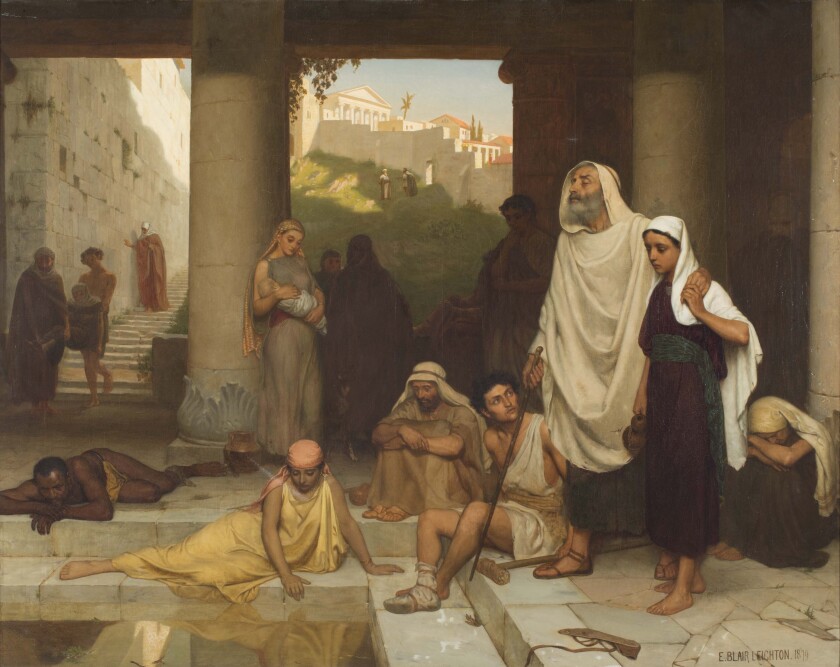
Edmund Blair Leighton (1852-1922), ‘The Blind Man at the Pool of Siloam’, 1879
In our Gospel we read about healing and sight and hearing. There are differences highlighted between physical sight, and all that our heart sees. We are also reminded of creation, of how our ties to this earthly gift are to be experienced as a gift of love, a gift of healing, a gift wonderful to behold and a gift of life that we are called to be at peace with. Seeing creation with the heart is a joy of God – a joy God wants us to see. God’s creation is immense and open, a cycle of mortal life in harmony, with eternal heavenly joy touching everything, in everything. This joy that lights life is vital to the path of our soul. The light shows us need and suffering, calls us to give of ourselves, and opens us to love and caring. Our lives are a pilgrimage and a journey of revelation of seeing how God sees. To see with God. We learn that the healing of bodies in this life is momentary, mortal, and yet amazing but the healing of spirit is always the beginning, and ever with us in God’s love. In seeing with God’s love, the living of God’s love is the light we too can shine, or reveal, as Jesus who is the light of the world.
And we also hear how humanity can possess the refusal to open the eyes of the heart, the refusal to see possibilities and change – a refusal to see, to know transformation. We hear about fear wrapped in the dangers of thinking that is scrupulous and caught in harmful restriction. Of being possessive and obsessive and avoidant. We see people rigid in believing they are right, in charge, unwilling to see through the eyes of the heart and disregarding truth before them – Truth of Healing. Truth of God rising new life, whole healing from Jesus own spit in the earth, washed with joy in water. Truth of God in their midst, Jesus the Christ.
And finally, we read of an interrogation, that lacks seeing and hearing, meant to expose or determine the identity of Jesus.
So much…
Best to share a simple discovery to ponder now… the pool of Siloam is fed by waters from the Gihon Spring, located in the Kidron Valley. The naturally flowing spring water would have qualified the pool for use as a mikveh for ritual spiritual bathing and purification, often to mark significant life transitions. If you will, the water of the Gihon Spring is living water, used to anoint Solomon as King. It is a life-giving source of fresh water.
I would also like to share two clear images of my own that arise from reading about Jesus’ healing with mud and spit.
According to my parents I didn’t really have a first word. More of a first cascade of words. One of my words was “dig”. I’d ask to go outside and dig almost continuously. I had some sand in the back garden but I’d also happily dig in the soil around flowers and trees. I grew up loving to dig in my garden, plant trees and flowers and smell the earth and see the new growth. New life. A Genesis memory.
Perhaps some of you can relate to my spit memory. Having a dirty face from play or from eating something like ice cream meant my mother (sometimes my father but usually my mother) if we were not near a tap, would spit on a tissue, or even her thumb and proceed to clean my face. It was always intimate, loving and safe, even as I might not have wanted to stand still. All of this was promptly followed by … you will need a bath later.
With the smearing of the mud of dirt and spit the blind man still cannot physically see, and even more his eyes are covered in the mud, when Jesus tells him he needs to go to the pool of Siloam. But he obeys without question. Though it is the end of the chapter when he fully sees and knows Jesus, calling him Lord, – the healed man sees goodness and trusts even without physical sight.
When he emerges from the pool healed, he is called to an interrogation about Jesus with the Pharisees. An interrogation in which the Pharisees had already made up their mind. With frustration, and most likely using points he has learned from the good teaching of the Pharisees, which they dismiss in annoyance at his audacity, the man says,
“We know that God does not listen to sinners, but he does listen to one who worships him and obeys his will. Never since the world began has it been heard that anyone opened the eyes of a person born blind. If this man were not from God, he could do nothing.” ….
I wonder if the blind man immediately stood still for the application of the spit mud. Jesus was after all, just walking along. Walking with him, the disciples wonder aloud who had sinned to make the man blind. In one very quick swoop Jesus dismisses the judgement of sin upon the body and dismisses the existence of cause and effect from God. God is about a loving transformation. We are all born with the capability of revealing God’s freely given work and love in our lives. And in the lives of all others we meet. Jesus gives the physical healing freely; the man’s trust grows into acceptance of the truth of Christ. He is ready to share and soon displays faith and discipleship. Like him it is our willingness to receive and discern God’s guidance and work in us that strengthens and deepens this Grace. Yet even when the man’s’ eyes are healed, a sign ordinary eyes can see, the frightened Pharisees only see that their world order is being upset and turned upside down. They so desperately, blindly need to adhere to their laws and dogma for God, that they miss God’s love in their midst. The religious constraints the Pharisees have in place hinder their ability to witness God’s faithful actions. They are blind, even while they protest how well they see. This kind of blindness is not limited to the Pharisees or to their time or to someone other than us. The idea that Jesus was just walking along and entered the life of this man in need and saw hope and light for new life in him and from him, is a challenge as well as a comfort and an image I can hold in contemplation…with this blessing written by Jan Richardson,
“That you will see in the way God longs you to see. That you will be given vision that speaks precisely to and through who you are. That the holy will reveal itself, unhide itself, divulge itself in you.”