By Sister Doreen, SSJD
The Anglican Church Calendar for the month of January quote: “We look not at what can be seen but at what cannot be seen; for what can be seen is temporary, but what cannot be seen is eternal” (2 Corinthians 4:18).
In The Message translation, 2 Corinthians 4:18 reads, “The things we see now are here today, gone tomorrow. But the things we can’t see now will last forever”.
The verse encourages focusing on unseen, inner spiritual realities rather than on visible, temporary circumstances. It reframes the challenge of life’s journey by urging us to look beyond present challenges and circumstances toward a greater, everlasting gift that cannot be seen with the physical eye but will last forever. Like Snoopy’s cartoon, some of those things would include gratitude, humbleness, appreciation, kindness, love … they seem to sparkle with the encouragement, the gift, the acknowledgement that indeed, it is these unseen gifts that last forever to help us rise and shine, for your light has come and the glory of the Lord is risen upon us!
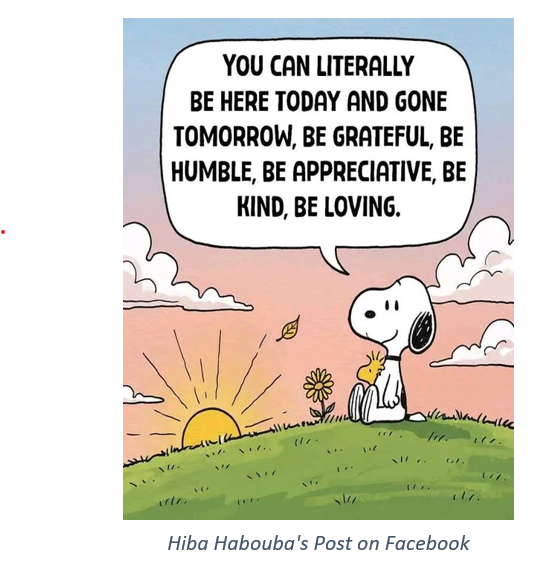
In the book The Little Prince, written by Antoine de Saint-Exupéry, there is a meaningful quote. “What is essential is invisible to the eye,” emphasizes that true value comes from love, relationships, and inner qualities, not from material possessions or superficial judgments. We sometimes forget that beauty and meaning in simple things are where true value lies, rather than in matters of importance. Throughout this book, different circumstances that the little prince encounters highlight the truth that the heart sees what is essential, that relationships are built through time, care, and the investment of compassion and love – it is this that makes people unique, precious, and important. It is the responsibility and care that makes people and situations and the world around us special and worth ‘fighting for’. In all of this, the message of the scripture passage and the story of the Little Prince spark a curiosity and open-mindedness, a sense of wonder. Snoopy wisdom tells us to be grateful, to be humble, to be appreciative, to be kind, and to be loving.
In pondering this scripture passage, a smile came to me – what I need in life’s journey are Gospel Glasses! This is calling for a shift in my perspective, one that helps me to maintain hope and not lose heart during all the changes and chances of life, all the seasons for life, all the challenges of light and darkness that I find myself confronted with and walking through in the daily round of my life. It’s an encouragement to place my hopes and dreams on God’s promises … ‘I have plans for you, plans for your good and not for your harm’. One of the great temptations of life is that our anticipation and our daydreaming of future joys and a better life-style, of something that will last forever, something that we can see and touch … it is a temptation that can sometimes rob us of a full appreciation of the many present joys – joys that are ours right here and now. It’s not the new car, a bigger home, or any of our material possessions that are going to make everything all right for us!
What we need and long for and desire when we open ourselves to look for these unseen things are things that are of greater value than anything this world has to offer: things like peace, love, joy, forgiveness, hope, compassion, belonging, kindness, gentleness, self-control and confidence – for friendship, acceptance, and the value of knowing that we are loved and cherished and precious, God’s own, held in an inclusive and unconditional and tenacious love. Over and over again, it should be ringing in our ears: “I have called you by name, you are mine … I have loved you with an everlasting love … you are the apple of my eye, and I hold you under the shadow of my wings.” And our response can only be Alleluia! Rise! Shine for your light has come and the glory of the Lord has risen upon you!
Joan Chittister suggests that this calls for an inner journey to peace. She emphasizes the need to listen. Silence, she points out, creates for us that essential space to think and thinking then allows us to grow in wisdom and come to an understanding that we do not have all the answers. Then, humility has a chance to help us grow and come to realize that we are all pilgrims on the same journey searching for a deeper relationship and understand of God, and for God in each other, those unseen things that last forever. But this is a challenge: it will take hard work to develop a discipline to practice silence and solitude which has been all but lost to us busy inhabitants of a noisy twenty-first century world. We need this wisdom, the wisdom of space, of listening, of silence to learn to look for and dwell in the unseen things that last forever.
Joan Chittister writes: “If we do not have a rich inner life, we will want to have the tinsel and glitter of the world around us, and someone else’s money to get it too. If we are insecure, we want to control others. If we are not at peace with our own life, we will make combat with the people around us. And if we do not learn to face our own struggles, we will never have compassion for the struggles of others. It is silence and solitude, in other words, that bring us face to face with ourselves and the inner wars we must win to become truly peaceful people.” I believe that there lie the inner things that are eternal!
“Elder, give me a word,” a seeker begged the desert monastic.
And the holy one said, “My word to you is, go into your cell and your cell will teach you everything.”
That point is clear and simple: All your answers are within you. And so are the questions, the questions that no one can ask of you but you. Everything else in the spiritual life is mere formula, mere exercise. It is the questions and the answers that are around you, within each of us, those unseen gifts, that in the end will grow our souls. Then, we will get to know ourselves, and then the Little Prince’s words will ring true for us: ‘it is only with the heart that one sees rightly’.
Silence does more than confront us with ourselves, however. Silence makes us wise. It gives us the space to reflect and to integrate our inner life. Make no doubt about it, there is an important truth here. To listen for the voice of God and to wrestle with the self is the nucleus of the spirituality of peace. It may in fact be what is most missing in a century saturated with information, filled with noise, smothered in struggle, but short on reflection and aching for peace.
John Newton’s hymn written many years ago sums up the call to not what is seen but to what is not seen, and what happens when we open ourselves up to this gift:
“Amazing grace! How sweet the sound that saved a wretch like me!
I once was lost, but now am found: was blind, but now I see.
It was grace that taught my heart to fear, and grace my fears relieved;
how precious did that grace appear the hour I first believed.
The Lord has promised good to me, his word my hope secures;
he will my shield and portion be as long as life endures.
Through many dangers, toils, and snares I have already come;
‘tis grace that brought me safe thus far, and grace will lead me home.
When we’ve been there ten thousand years, bright shining as the sun,
we’ve no less days to sing God’s praise than when we’d first begun.”
Arise shine, for your Light has come, and the glory of the Lord is shining upon you!