By Archbishop Linda Nicholls
We all want a Saviour! We want someone to solve our problems; fix what is wrong in the world; heal our wounds; and make us feel ‘good’ again – especially in light of all that is around us at present.
In the great arc of the relationship between God and humankind over history it began with direct communication. We hear the story of the intimacy of God with Adam and Eve in the Garden of Eden, walking together in the evening. Even though that relationship is disrupted by sin God continued to speak to Noah, Abram and Sarai, Jacob and Isaac and Moses – in words, in visions and in dreams. But our human capacity to turn away – to sin – continued to thrive and separated us from God. Hearing God and obeying became challenges.
By the time of 1 Samuel 8 the people are clear that they want a king! Judges were not enough – and in Samuel’s time were corrupt. They wanted someone like the kings of other nations. Someone to fight for them and be present now. Samuel tries to warn them that a king would conscript their sons as soldiers, their daughters as perfumers and bakers and would tax them! They continue to insist and God tells Samuel to anoint a king. Saul – then David – then Solomon soon prove that kings are very human. They are flawed and sinful and fail to live into their covenant with God. They are followed by a series of kings who value status, power and greed over relationship with God. The occasional one tries to reform the community but ultimately the failures of the kings lead to victory for their enemies and Israel and Judah are carried off into exile. Centuries of foreign governments rule the land and the remaining people, sometimes with puppet kings like Herod, under Roman occupation.
In the midst of the heartbreak for God of these failures God sends prophets to call the people and their leaders back to faithfulness. God plants vision of what could be as prophet after prophet cries out to little avail.
In a final act of love God comes into our world in human form in Jesus, showing how a king might look very different! Jesus teaches, heals, and challenges systems with the gospel of God’s infinite love, mercy and forgiveness. He offers living water to the Samaritan woman and sight to the blind man. He draws the law back into the orbit of love and grace.
Opposition has been growing to his words and actions. Jesus’ words are clear to those listening – they unmask the distortions and manipulations of God’s love to meet personal needs.
Now on this day Jesus brings it together as he announces to the disciples, “we will go to Jerusalem’. He knows there are growing tensions and anxieties that will already be high as the Passover will soon be celebrated. Any celebration by an oppressed people of a past liberation will be provocative to the oppressor. Rome will be on high alert and religious leaders will want to avoid exacerbations.
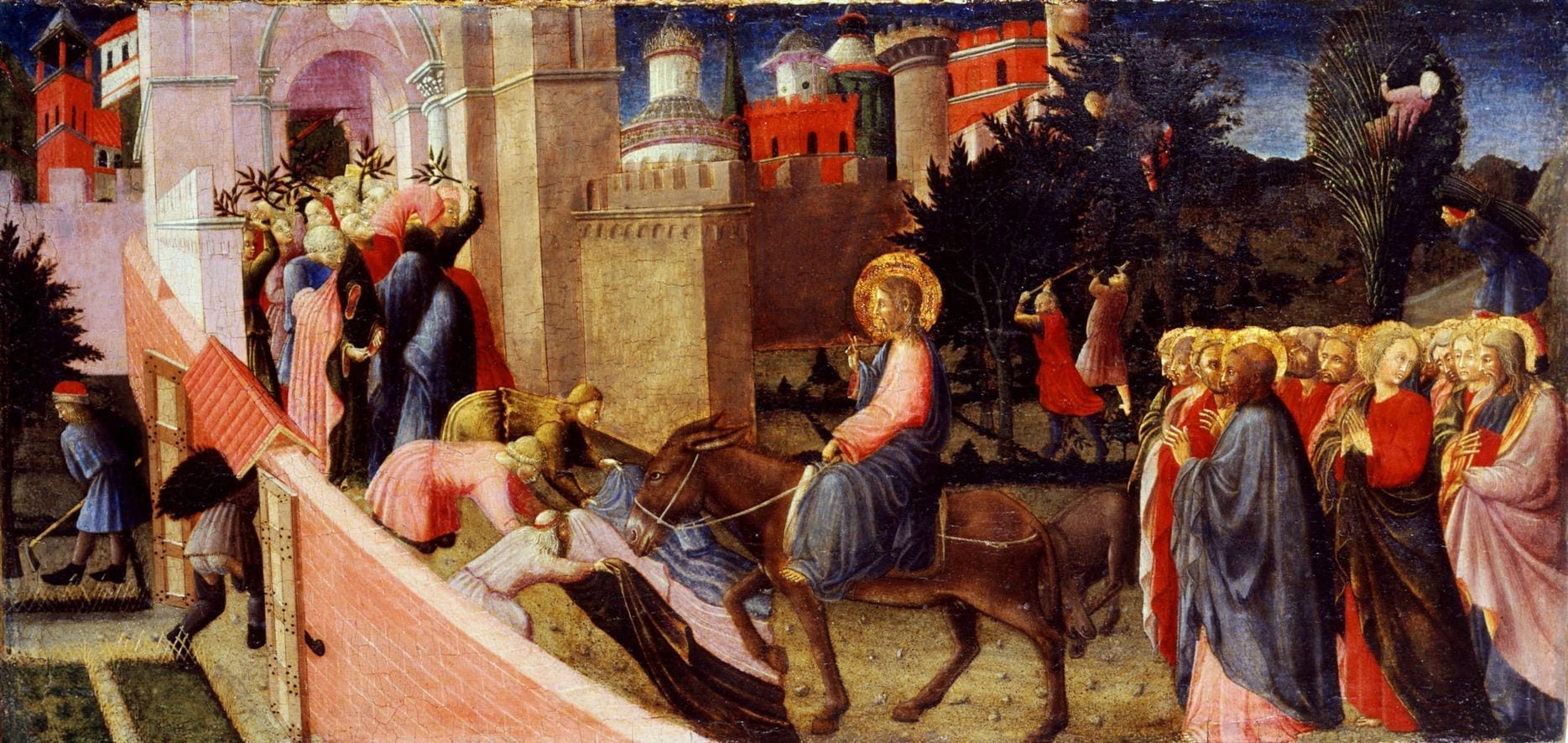
Jesus asks for a donkey and a colt to ride, echoing the prophecy of Zechariah 9 – “..and your king will come riding on a donkey, on a colt the foal of a donkey”. Those familiar with scripture will see and know the connection of kingship and this action. We will leave aside the untidiness of imagining Jesus riding both of them at the same time – this is about a sign and fulfilment of prophecy!
Jesus is signalling that he rides into Jerusalem as a king, coming in victory and in peace. This not a call to revolution or to arms. He would have ridden a war horse for that. But it is still a challenge….and what an ironic challenge it is.
Donkeys are not fast – they are not majestic. They are uncomfortable to ride and notoriously recalcitrant! I recall seeing a teacher re-enacting the triumphal entry riding in the school yard on a donkey. He was very tall so his feet were dragging on the ground. Hardly an image of majestic rule.
Jesus subverts expectations and comes in this peaceful, slightly ridiculous, foot dragging way as people claim him as a prophet. His kingdom is not a physical one but it is still provocative because changed inner hearts change the world around them. Jesus likely knew this would be seen as seditious. I imagine his own heart must have ached in the same way as when he wept over the city of Jerusalem. But the people see only hope filtered through the lens of their own dreams. ‘We want a king like David to return and rescue us – and we believe, Jesus, you are the One!’
Some religious leaders see only disruption and a troublemaker for them.
Some people are simply curious – ‘Who is this?’
Roman officials are not too concerned yet but will soon give into the fears and make Jesus expendable.
Judas believes Jesus has not done enough.
Disciples are initially afraid to enter Jerusalem but then exhilarated at this moment of acclamation and being close to someone who could change everything for them.
Except Thomas. He had caught a glimpse of all that this might mean. When the others initially resisted going to Jerusalem, Thomas simply says, ‘Let us go and die with him’. He could see the cost ahead.
Swirling emotions and expectations are all around – hope and fear mingle.
We love this image of Jesus on a donkey, riding into the city, being hailed as the Son of David with Hosannas! Children delight in the palm parades and play swords with the palm fronds. We blithely celebrate with smiles and laughter, partly because we know the ending will be joy next Sunday. Yet this is the ultimate image of an irony we don’t want to admit.
Barbara Brown Taylor writes about leading a retreat and asked the participants, ‘Who represents Christ in your life?’ A woman replied, “I thought about who told me the truth about myself so clearly that I wanted to kill him for it?”
Jesus showed people truth about their relationship with God and one another. Some rejoiced – like the Samaritan woman who ran to tell others – while others found that truth too hard to hear and their denial turned to rejection and death for Jesus.
Today launches the final confrontations between truth and life and sin and death. Jesus acts in a way that proclaims his identity as a king but unlike those around him. He is a king of peace, using love and mercy to change hearts and build community. It will be costly.
The power of darkness are strong indeed. We are called with the disciples to go with him into the tensions of this week – into the heart of darkness – into his death – in order to know the true power of God to bring life. May God grant us the courage we need for the journey into the days ahead!