By The Rev. Canon Joanne Davies, Oblate, SSJD
The journey is not about power but the joy of being God’s own, and the love given and received as obedient hope-filled followers of Christ.
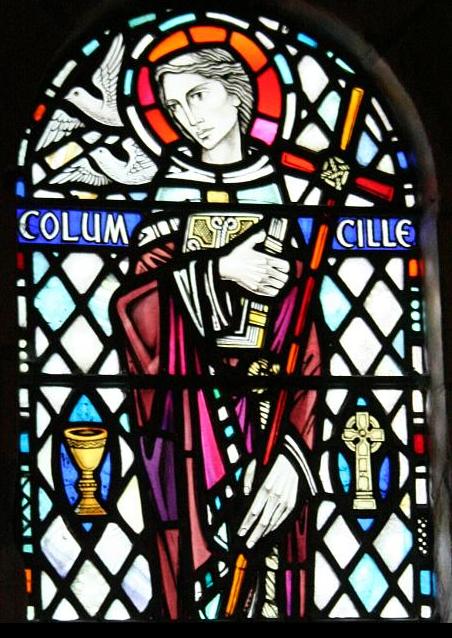
St Columba, also known as Colum Cille in Irish, was born in Gartan, County Donegal, Ireland in 521 and was descended from Celtic Chiefs and Warrior Kings. Columba is Latin for Dove just as Colum Cille is Irish for Dove of the Church. It is not known if Colum was his birth name or if he chose to name his life as one guided by the Holy Spirit.
St. Columba is one of the great founders of Celtic Christianity and a 6th century Irish missionary to Scotland. His noble birthright destined him to be a great king, but he answered a call to be a monk and a founder of monasteries. Colum was deeply in love with the mystical beauty of Celtic Ireland, drawing into his Christian faith the Druid belief that was all around him, the belief that every part of nature holds the sourcing and web of life. Finding God in all things.
Columba’s decision to leave Ireland appears to be directly connected to an early copyright dispute. Columba, while visiting his mentor, apparently copied St. Finian’s psalter work and illuminations. St. Finian and his followers became very upset with Columba for doing this. Columba’s fellow noblemen came to his defense and this tension gave rise to the Battle of the Book, a battle resulting in many deaths. Columba felt responsible and deeply guilty for this bloodshed. He sought to make penance.
One way that Celtic Christians made penance was by going on what is called a “peregrinatio,” a pilgrimage of no return, a pilgrimage to the place of one’s resurrection, where one would die and hopefully rise again in Christ. So Columba, with 12 monks, went on a peregrinatio by embarking north on the sea in a round canoe-like boat called a coracle, or curragh in Irish, following the guidance of the Holy Spirit, in the wind, the waves, and the wild geese.
“God called Columba
from the privilege of a princely family,
from the power-base of an Irish monastery,
from the solace of well-known
faces and familiar rituals,
to the martyrdom of exile,
to a voyage into the unknown,
in a frail curragh with a few followers,
making a series of landfalls
as he tried to find the place
where God was calling him
to begin all over again.”
Around 563, the monks came ashore, at what is now called Columba’s Bay at the island of Iona about 60 miles north of Ireland. They dragged their curragh or coracle ashore over the stones, Iona greenstone, now called Columba’s tears. To follow God’s call. To begin again.
At Iona, Columba, led by the Holy Spirit, let go of his past in Ireland and he prepared for a new beginning, which is why the bay upon which he landed is also called the Bay of New Beginnings. Columba built his monastery and home on Iona and from there he became a beloved evangelist to the people of Scotland and later to northern England. Beginning again. Columba was known as a healer, a miracle worker, a tamer of wild beasts (a list which includes the Loch Ness monster) and a seer and visionary who communed with angels. Columba continued transcribing his beloved Psalms, every day. On the day of his death, he transcribed Psalm 34 verse 9, “Those who seek the LORD shall lack nothing.” At Vespers he offered a final blessing to his monks, “Be at peace. Love one another. The Holy Spirit will be your comfort and advocate and will provide everything you need.” He died in the last light of that day June 9, 597. A heavenly light of rest in new life.
“O God
we find it hard to let go
of all that gives us status or security;
we cling on to the grief and grievances of the past;
we talk about putting our trust in you–
but we struggle;
we hear your call –
but find it hard to take the first step.
You care for our human frailty –
forgive us when we fail;
when you call us again,
give us courage to follow you.
…. May we open our hearts and souls to the spirit of foolishness with you, O God. Always we begin again.
With thanks to Jan Sutch-Pickard. Bell, Book and Candle: A liturgy for St. Columba’s Day, Wild Goose Publications