By Sister Doreen, SSJD
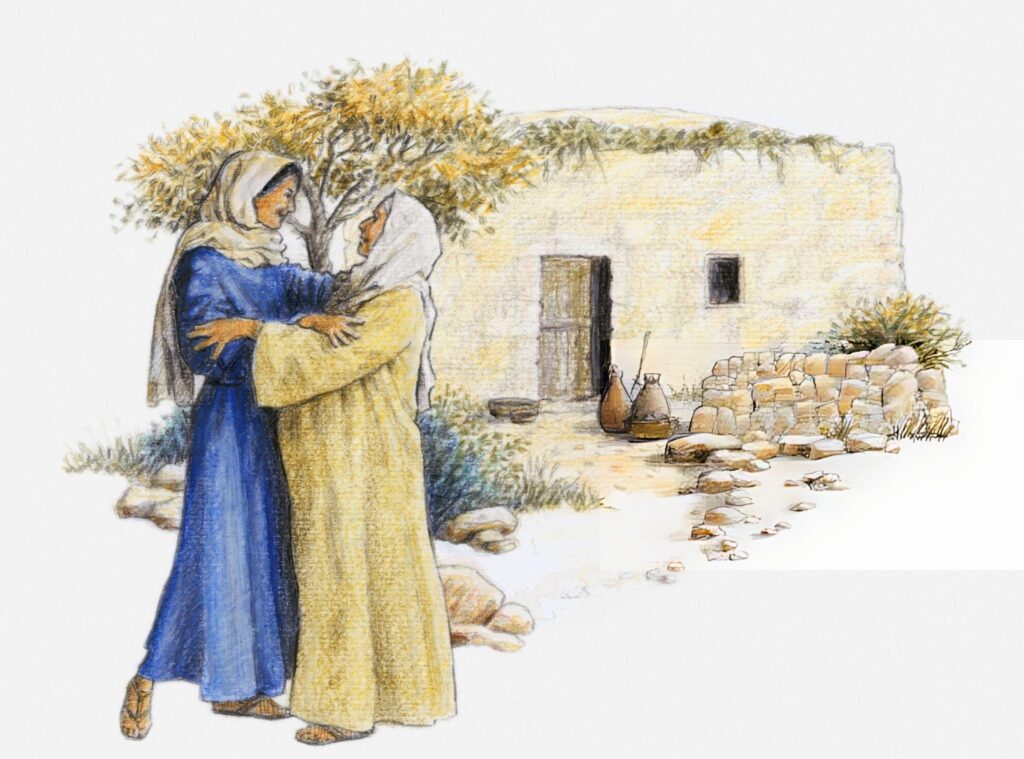
“In those days Mary arose and went with haste into the hill country, to a city of Judah, and she entered the house of Zechariah and greeted Elizabeth.” (Luke 1:49).
She went in haste – those words stood out for me this year as we celebrate the Feast of the Visitation of Mary to her cousin Elizabeth. There are so many instances in scripture of ‘going in haste! Two stand out for me – Exodus 12:11 the Israelites were instructed to eat the Passover meal ‘in haste’, prepared to leave Egypt immediately; Luke 2:16 the Shepherd’s after hearing the news “went in haste and found Mary and Joseph, and the baby laying in a manger”. In pondering these stories of going in haste, it seemed to me that they all three involved being purposefully in a hurry, quickly, eagerly, and with zeal. And in each instance the ‘in haste’ was followed by a prompt response or action – one of promise, faith, and joyful service. Elizabeth and Mary both sang songs, the Shepherds returned praising God, and the Israelites left in joyful expectation for the promised land.
I found myself thinking that Mary’s visitation to Elizabeth, a visit and a blessing, was proposed to us as an example of our own visitation, in haste, of bringing the good news, the gospel —of actually being involved in evangelism – bringing the good news of Jesus to others through acts of love and service. In our baptism we were asked ‘Will you proclaim by word and example the good news of God in Christ?’ and we said yes! And ‘will you seek and serve Christ in all persons, loving your neighbour as yourself?’ and we said yes! These three scripture stories quoted are models of bringing the gospel good news with astonishment, acceptance, and real treasure, and with an invitation of being welcomed into the arms of a loving God.
In the story of the Visitation of Mary to Elizabeth, Mary’s willingness to journey to Elizabeth in her time of need encourages us to reach out in love and compassion to those around us. Mary shows what it means to bring Jesus to others—not just through words, but through genuine acts of kindness, compassion, and selflessness.
There is a two-fold message and miracle in the story of Mary’s visit to Elizabeth: we see Mary’s ‘in haste’ as reminding us that we are called to bring Jesus to others; and at the same time, we see Elizabeth’s response as reminding us that we are called to recognize the presence of Jesus in others. In both of these actions we are called into prayer as a radical response to real-life’s situations, real-life’s mysteries and miracles. In both there is summed up the two questions in our Baptism that we said ‘yes’ to!
Bringing Jesus to others by our faith and by our compassion and love, by our words and by our actions, by knowing the Gospel and by living it as fully as we can each and every day is hard – very hard! It’s not easy to recognize the presence of Jesus in each other. Let’s be honest about it, it’s very difficult to be conscious of the presence of God in certain people that we have to deal with: the people who dislike us, who hurt us, who slander us, who use us, who betray us, who steal from us. We need help, we need that deeper intimacy with God and God’s promises to help us see that in spite of the bad things they’ve done to us, they are still created in the image and likeness of God and loved by Jesus. We need that deep prayer that opens us up in these times of critical life moments to help us be aware of these things because they are very, very easy to forget. It is these mysteries of life with which we wrestle and struggle that are the warp and woof of authentic prayer. As Matthew Fox writes in his book “On Becoming a Musical, Mystical Bear”: “Life is respected as a mystery that carries us beyond the particular moment or particular culture to a God who simply is and in whose intimate presence one dares to stand with confidence … God is bigger than life with its mysteries and its problems. A mystery of mysteries, God is everywhere life-giver. God is the lover of life above all else: its preserver, its promiser, its enticer, its sharer.”
But the crucial question God is asking us is this: will we run in haste after what matters most? Matthew Fox continues words of challenging wisdom when thinking about evangelism as both taking Jesus to others and finding Jesus in each other, the Mary and the Elizabeth response to “in haste”. He says: “The understanding of prayer as a radical response to life suggests the following lesson. That a new commandment has been given to us: you shall love your life with all your strength and energy, growing daily in appreciation of the joys of life; and you shall allow and aid where possible your neighbour to love theirs and do the same, using common norms of justice to determine life’s priorities. Live to make life livable: fighting when necessary, learning by whatever means possible, having a good time when you feel like it, respecting life’s mysteries in an active, not a passive manner. In short, love life – and do whatever you want.”
The feast of the Visitation as we celebrate it this year was a deep reflection around the invitation and the commission that we are all called to bring Jesus to others and at the same time we’re called to recognize the presence of Jesus in others. The central message of the Visitation revolves around our understanding that real love is self-sacrificial – both in the sharing of it and in the recognizing of the presence in and with each other, a challenging call that has an impact and influence on our lives.
Mary’s song embodies the same reflections – one that rises out of her own personal ‘yes’ to the mystery of life and God’s love. There are many translations of the Song of Mary, the Magnificat – I would like to share one that has a particular meaning for me, it is written by Joy Cowley.
My soul sings in gratitude, I’m dancing in the mystery of God.
The light of the Holy One is within me and I am blessed, so truly blessed.
This goes deeper than human thinking, I am filled with awe
At Love whose only condition is to be received.
The gift is not for the proud, for they have no room for it.
The strong and self-sufficient ones don’t have this awareness.
But those who know their emptiness can rejoice in Love’s fullness.
It’s the Love that we are made for, the reason for our being.
It fills our inmost heart-space and brings to birth in us, the Holy One.
With our own response of “yes” we too can serve those in need, to bring comfort, and to share the joy of God’s presence. The Visitation is a reminder that true faith is always accompanied by action—that we live a faith that reaches out, supports, and uplifts. Do we dare to call ourselves ‘evangelists’? or perhaps a better question would be: do we dare not to call ourselves ‘evangelists’? For what we are and what we are called to be are evangelists of God’s presence – traveling in haste to share the good news and to see in each other the face of God. A hymn for the hymn book ‘Gather’ #744 written by Ruth Duck to the tune Beach Spring, 86 86 D:
As a fire is meant for burning with a bright and warming flame,
So the Church is meant for mission, giving glory to God’s name.
As we witness to the gospel, we would build a bridge of care.
Joining hands across the nations, finding neighbours everywhere.We are learners; we are teachers; we are pilgrims on the way.
We are seekers, we are givers; we are vessels made of clay.
By our gentle, loving actions, we would show that Christ is light.
In a humble, listening Spirit, we would live to God’s delight.As a green bud in the spring-time is a sign of life renewed,
So may we be signs of oneness mid earth’s peoples, many hued.
As a rainbow lights the heavens when a storm is past and gone,
May our lives reflect the radiance of God’s new and glorious dawn.
Yes! Yes! “Arise shine for your light has come, and the glory of the Lord is risen upon you.” Isaiah 60:1.