By Sister Doreen, SSJD
Jane Tomaine in her book St. Benedict’s Toolbox wrote: “Ever since I was a child, one of my favourite pastimes is working on jigsaw puzzles. As I find each piece and fit it into place, a beautiful scene begins to take shape. … Piece by piece the work is completed. How like a jigsaw puzzle is the work of God in our lives! Like the pieces of a puzzle, God places the seemingly disparate pieces of our lives into a picture that, for a time, only God knows. All along the way, through the circumstances of our lives and the choices we must make, God says to us, ‘Here my child, take this piece; place it here. Now this piece. Now another. And another.’ until some form or pattern begins to emerge that we can see.”
This was a fitting jumping off spot for me to reflect on the life and Rule of St. Benedict. The foundation of our Community within the Anglican tradition was and is today modelled on what I believe Benedict encouraged: a watchful, all-inclusive approach to life – a life-giving way – that put God at the centre of life while remaining connected to people, and open to listening for God in everything – a life rooted in relationships with God, others, and to ourselves. Perhaps it has always been so for people seeking more of life, however I believe today that we are in a very crucial dilemma – life is so often out of balance as we are stretched one way or another. It is easy to find ourselves out of touch with the things that are important to us: no time for family and friends, no time for ourselves, no time for God. In a very real sense technology has changed the way we live: we seem to be ‘on call’ all the time, work and home boundaries get blurred, and the distinctions between community and solitude no longer seem to fit our cultural lifestyle. Everything is ‘in our face’, everything demands immediate response, the world that seemed so wide and far away is now up close on our TV screens where we get instant news in a world that seems to have shrunk onto our doorstep! There seems no where to go, to find myself, to reflect and ponder below the surface exterior of what is going on, to be in touch with those inner values that are so important for healing, for hope, for courage and resilience, for new life.
Benedict understood these dilemmas in his day, and the wisdom that he shared to help live a less fragmented and more fulfilling life continue to ring true today. His was a simple wisdom that promoted a way of life that was rooted and grounded in God, a centre of stability in a world that today is so broken, fragmented, and fragile. His simple wisdom is so reassuring in the way that he accepts the frailty of our human nature while also believing in our human potential as people made in the image of God. Benedicts holistic approach to life speaks a language that resonates with other traditions and speaks to the wholeness, the oneness, the interdependence of all of human kind and the universe, the cosmos. To know that God loves us with a tenacious and unconditional love, is involved in every aspect of our life, that listening, relationships, balance, reflection – deep pondering – can change our lives and offer us new life and hope – this is Benedicts gift encouraging a spirit of balance, moderation, and reasonableness – gifts that the world, that our own hearts, is crying for.
Joan Chittister wrote in her book The Rule of Benedict: a spirituality for the 21st century: “The Rule of Benedict is a spiritual guide, rare by virtue of its ancient origins, valued for its continuing meaningfulness in every century since. It has weathered every period of Western history since the fall of the Roman Empire and been a dynamic source of light and energy to each. Surely someone ought to ask, How is it that anything can last that long and still be considered viable in ages so distant from its own? Someone ought to care why it is that this way of life has been found to be both holy and helpful, whatever the social changes of the era, whatever the pitfalls of the time. Someone ought to wonder, then, in what directions, if any, would this Rule point our own lives in a period in which every system in the Western world – government, economics, family, social-values, and human relationships – is once again in flux?”
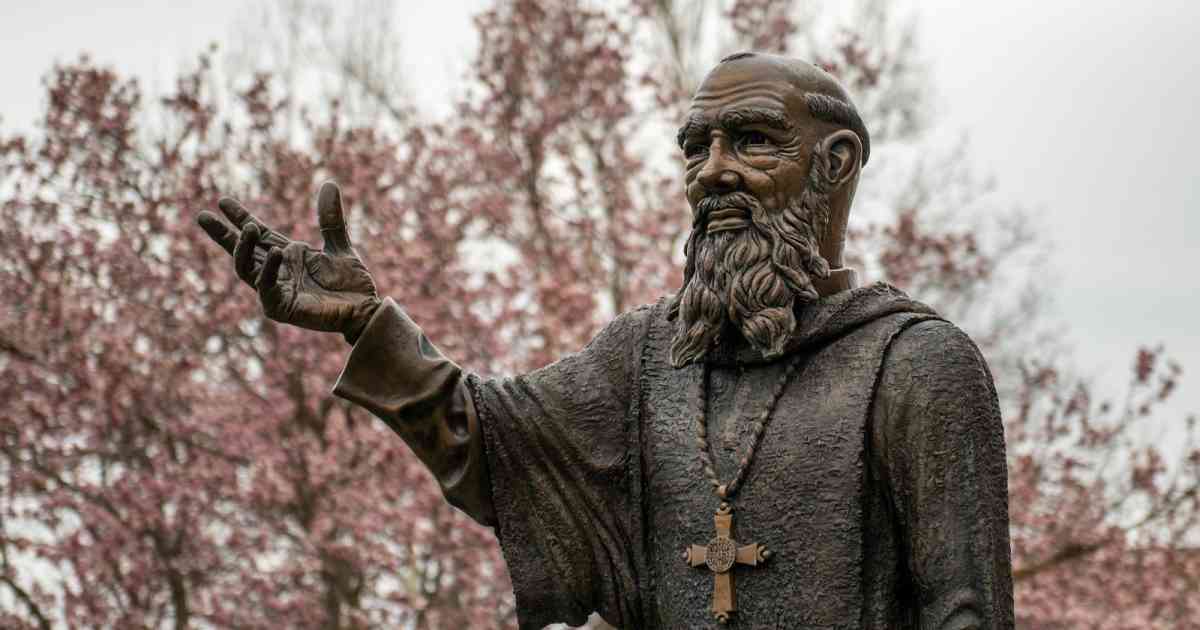
What about Benedict himself? He was born around the year 480 and into an age of disintegrating unity and social and economic insecurity. He was the son of a Roman noble of Nursia, in Umbria. He was sent to Rome to study but was disappointed by the academic studies he encountered there, and left Rome and settled in the Simbruini mountains about forty miles from Rome, and near Subiaco. He lived as a hermit for three years – three years of solitude – and Pope Gregory’s account of Benedict during this time was that “he matured both in mind and character, in knowledge of himself and of humankind while at the same time became not merely known to, but secured the respect of those about him.” Over time he founded 12 monasteries and in 530 founded the great Benedictine monastery of Monte Cassino which lies on a hilltop between Rome and Naples.
St. Scholastica (c. 480–543) was an Italian Christian saint and the twin sister of St. Benedict of Nursia. Known as the foundress of Benedictine nuns, she established a convent near her brother’s monastery at Monte Cassino. They supported and encouraged each other, meeting once a year to discuss spiritual matters, sharing a close bond.
He wrote the Rule for monks living communally under the authority of an abbot, a rule in its wisdom that is twofold: spiritual (how to live a Christocentric life on earth) and administrative (how to run a monastery efficiently). Benedict’s Rule was what he termed ‘a little rule’ to help the monastic communities to better love God, self, and one another by providing some guidelines on how to live a spiritual life in community. It covers the essentials of worship, work, study, prayer, personal conduct, the use of time, relationships, leadership and authority, hospitality, and possessions. Joan Chittister wrote: “The Rule is designed for ordinary people who live ordinary lives … it was written to provide a model of spiritual development for the average person who intends to live life beyond the superficial or the uncaring … to live the Rule involves not a set of mechanics but a change of heart and mind.”
The Rule of Benedict is a document and a lifestyle that is over 1,500 years old and as Joan says: “in which in every era it becomes increasingly more important as we fumble and stumble our way toward fullness of life in a world whose foundations are shaking.” The Rule of Benedict is a way of life, a life-giving way, and is for everyone who is on a journey, the coming home of the prodigal to the loving embrace of God. It is a call to listen for God in our daily lives and to find God in the people and in the world around us. “to do this we need to be present right where we are at any given moment. Benedict asks us to live in the present moment. He says, stay put (stability), listen to the people and to life around you and respond to who God is calling you to be and what God is asking you to do (obedience), and be open to the ways in which God will transform you as you live the Christian life (conversion of life). Benedict wants us to live in the present moment, fully alert to the now and ready to respond, whether we are at work, with our family, with friends, or with God in prayer. How hard that is! Our thoughts race between yesterday, today, and tomorrow. As people speak to us, our own minds form silent words: words that we want to say in response, words that judge, words that love, words of mistrust, even words for our grocery list! We’re often distracted by sounds around us. How difficult it is to be really present to the world that’s right before our eyes and ears – a world brimming full of God’s presence and light! Taking time to really look at life and be aware of all that’s around us is a skill that can help us to live in the present moment, seeking God in everything. It takes practice, practice, practice! I hear ringing through Benedicts councils in his Rule … listen, listen to the gospels, the rule – the stability, the obedience, the conversions of life -listen to one another, listen to the world around you. Just listen and keep on listening!
“A Benedictine spirituality …requires meaningful contact, a common vision, and the beating of a cosmic heart big enough to embrace all of life.” – from A Little Rule for Beginners: Insights into Benedictine Spirituality by Joan Chittister
Yes! Yes! “Arise shine for your light has come, and the glory of the Lord is risen upon you.” Isaiah 60:1.