By Sister Doreen, SSJD
While watching the baseball game between the Toronto Blue Jays and the Santago Tigers there appeared this advertisement: “He gets us. He gets all of us”. And this gave me a surprise pondering …. How true it is – God gets us, God gets us, all of us!
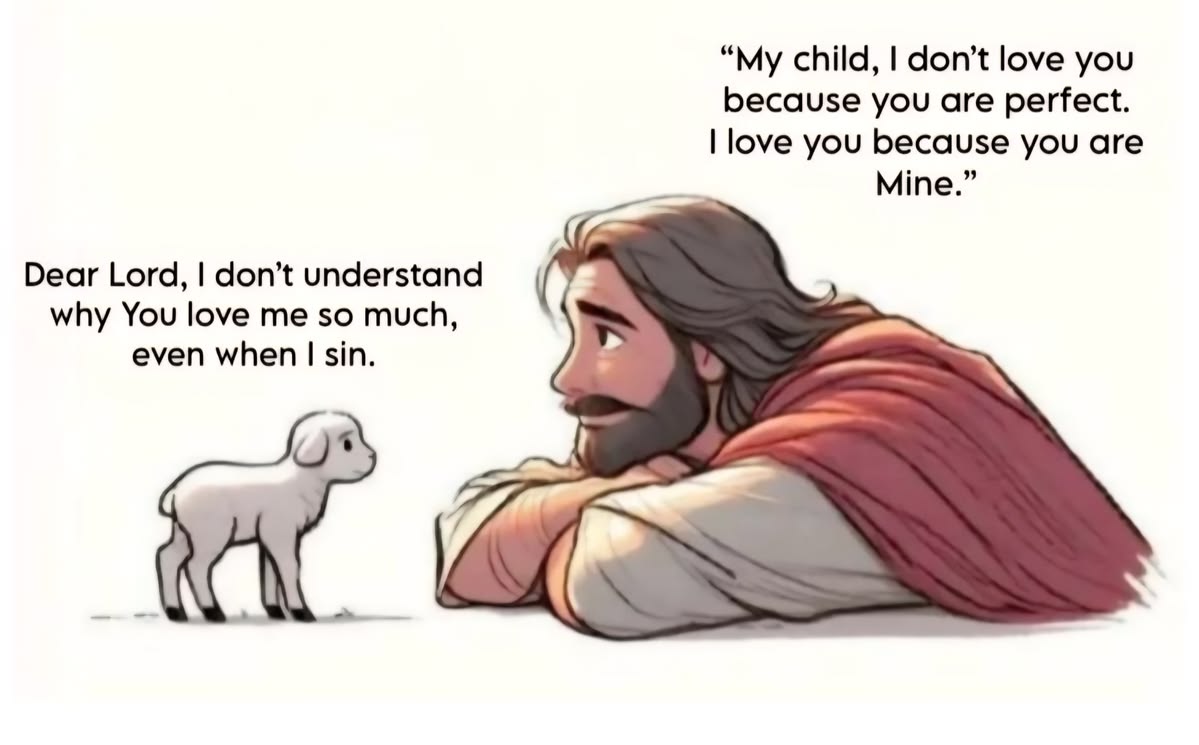
Once I found myself intrigued by the advertising and began to ponder it, I soon learned that it was an American campaign, and looking for information on the internet found this explanation “He Gets Us is an ongoing American religious advertising campaign formerly operated by the Servant Foundation.[1] First launched in 2022, the campaign’s stated goal is to ‘reintroduce people to the Jesus of the Bible’. Its campaigns are designed to cater to younger demographics and religious skeptics via allusions to present-day social movements, with an emphasis on values such as inclusion, compassion, and “radical forgiveness”. (quoted on Wikipedia website)
Sometimes billboard slogans, messages on Splenda packages, advertising on TV or some other eye-catching place, start me thinking about my own life and desire to continue to grow into more of me. My intention in this reflection is not to support nor to enter into the arguments about the movement / campaign, but to ponder instead the cartoon that I found that says it all for me when pondering the words ‘He gets us, He gets all of us’ – for me the message He gets us is that mystery miracle of God that says to each one of us “I love you because you are mine.”
It also brought to mind something that Max Lucado in his book “He Gets Us” wrote: “Jesus understands our lives because he was human too. He faced the same hardships and personal struggles that we encounter on a daily basis. He felt our deepest sadness and experienced our darkest solitude. Above all, Jesus gets us. In Jesus’ time, communities were deeply divided by bitter differences in religious beliefs, political positions, income inequality, legal status, and ethnic differences. But where was Jesus in all of this? Did he align with the religious elites? Or did he start an uprising to overthrow them? Neither of the above. Instead, he went from town to town, offering hope, new life, and modeling a different way to live and to change the world. Instead of pursuing power, money, or religious authority, he shared a loving and sacrificially generous way of living–he championed a better way.”
As we read scripture, noting especially the prophets, those people God chose as messengers whose main job was speaking truth, teaching moral lessons, and guiding people. In every sense these prophets were just like us. Everyone of them was only slowly converted to God’s cause. It is a fruitful time to ponder the call and deep accepting understanding God has for all of us, as seen in God’s call and acceptance of the prophets.
Isaiah despite his own sense of inadequacy finally offered himself for God’s service: “Here am I! Send me.” His task was no light undertaking; he was to condemn his own people and watch the nation crumble and perish. As he tells it, he was only too aware that, coming with such a message, he would experience bitter opposition, willful disbelief, and ridicule, to withstand which he would have to be inwardly fortified. All this came to him in the form of a vision and after a long inner struggle ended as a sudden, firm, and lifelong resolve,
Jeremiah projected his own emotions onto God, he responded to God’s call to prophesy by protesting “I do not know how to speak, for I am only a youth,” but he received the assurance that God would put words into Jeremiah’s mouth and make him a “prophet to the nations.” Jeremiah continued to call the people to reform, believing they dealt too largely with the externals of religion and not with the inner spirit and ethical conduct of the people. He called the people to repentance, and throughout his life suffered inner doubts and conflicts as well as joy and delight between his natural inclinations and his deep sense of vocation to deliver God’s message to the people.
Amos might have just enjoyed being a contrarian, someone who always took a contrary side. He was consciously aware of his humble origins. He was not a professional or trained court prophet but worked as a shepherd and a tender of sycamore-fig trees. In spite of a humble and contrary nature, he preached a fierce message of social justice, moral accountability, and divine judgment against the wealthy and powerful in the Kingdom of Israel. He warned that outward religious ceremonies and sacrifices meant nothing to God if people lived dishonestly and practiced daily injustice. He declared that God’s moral standards apply to all surrounding nations as well as Israel, despite Israel being the chosen people. His was no easy task, he was reluctant at first and then fervent and inspired towards the end.
Like the prophets it seems that we can only learn great things gradually! All the prophets walked through insecurity, questions, and doubts before they became strong witnesses for God. It took a long time to really believe that God gets us, God gets all of us – that God loves us because ‘you are mine.’ How often my own life echoes what Henri Nouwen wrote: “Is there a quiet stream underneath the fluctuating affirmations and rejections of my little life? Is there a still point where my life is anchored and from which I can reach out with hope and courage and confidence?” And yet, after my own deep desires, he could also say: “My Lord God, I have no idea where I am going. I do not see the road ahead of me. I cannot know for certain where it will end. Nor do I really know myself, and the fact that I think that I am following your will does not mean that I am actually doing so. But I believe that the desire to please you does in fact please you. And I hope I have that desire in all that I am doing. I hope that I will never do anything apart from that desire. And I know that if I do this you will lead me by the right road, though I may know nothing about it. Therefore, will I trust you always, though I may seem to be lost and in the shadow of death. I will not fear, for you are ever with me, and you will never leave me to face my perils alone.”
Saint Paul: at the end of his meditation letter about the way of love in chapter 13 ends his description of love with these words in the Message Translation “Love never dies. Inspired speech will be over some day; praying in tongues will end; understanding will reach its limits. We know only a portion of the truth, and what we say about God is always incomplete. But when the Complete arrives, our incomplete will be canceled.” ” (1 Cor. 13: 9-10) This is true for all of us, in every age. We change and grow up, learning by our mistakes. This is really at the heart of what we call conversion or repentance, and we should remember that it is seldom, quite seldom, in fact never, a one-time affair!
He gets us, he gets us, all of us! If we are trying to understand how God moves in the world, searching questions will do us so much more good than firm answers! But oh, how we would like, how we would like answers, and order, and clarity! But it is through change, growing up, making mistakes – that self-correcting path, that moves us into fullness of life. Those of us who love order need to be humbled by the experience of holy disorder! Those working through disorder need the insight of reorder and a major respect for some basic order, and any new reorder or change will soon need a further disorder and change!
Joyce Rupp wrote a meditation in her book called “Inviting God In”: “Do we ever fully realize how amazing the love of God is for us? No matter how seared, smudged, and stained our life may be, we will always be received in the merciful embrace of God when we choose to return. To be loved freely by God is a tremendous thing. It is to be received without doubt or hesitation, to always be regarded as the beloved and cherished one. Go stand in front of a mirror. Look fully into your eyes and say, “God is crazy about you.”
Yes, yes, God gets us, God gets us, all of us.
Close with a meditation on a hymn from Common Praise, Anglican Church of Canada #621 by John Bell:
“Before the world began, one Word was there, grounded in God he was, rooted in care;
By him all things were made, in him was love displayed, through him God spoke, and said,
“I am for you.”
Life found in him its source, death found its end; light found in him its course, darkness its friend.
For neither death nor doubt nor darkness can put out the glow of God, the shout
“I am for you.”
The Word was in the world which from him came; unrecognized he was, unknown by name;
One with all humankind, with the unloved aligned, convincing sight and mind,
“I am for you.”
All who received the Word by God were blessed: sisters and brothers, they of earth’s fond guest.
So did the Word of grace proclaim in time and space and with a human face,
“I am for you.”
Yes! Yes! “Arise shine for your light has come, and the glory of the Lord is risen upon you.” Isaiah 60:1.