By Sr. Constance Joanna, SSJD
“Is the Lord among us or not?”
That is the question the Israelites asked Moses. They quarreled and tested the Lord, we are told in our reading this morning, and said, “Is the Lord among us or not?”
So God arranged for Moses to provide water from the rock. The Lord was clearly among them.
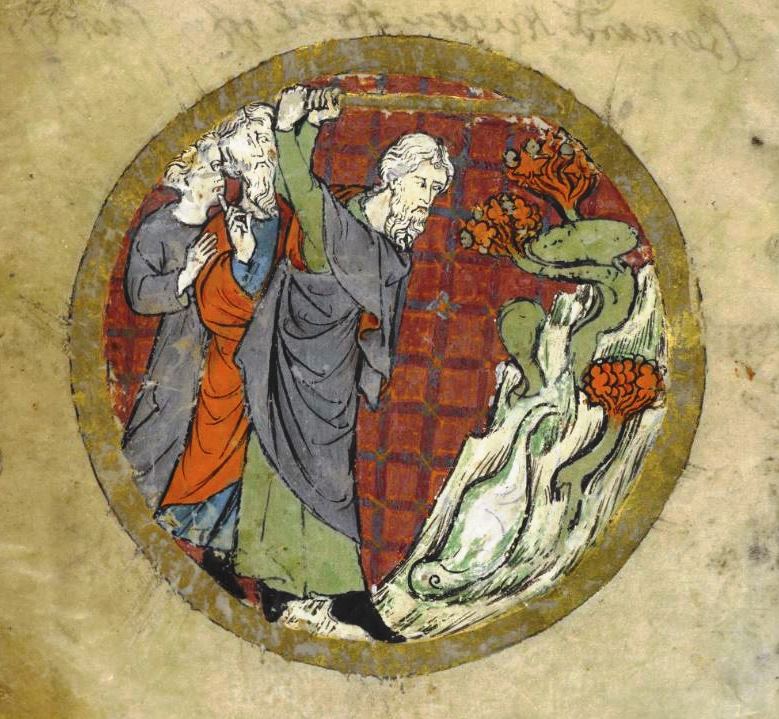
But they weren’t satisfied very long. The whole history of the Hebrew scriptures is one long saga of God providing for the needs of the people, the people complaining that the Lord was ignoring them, and then God providing what they asked for. As the psalmist says,
“he worked marvels in the land of Egypt . . .
he divided the sea and let them pass through it
and made the waters stand like a heap.
In the daytime he led them with a cloud, and all night long with a fiery light.
He split rocks open in the wilderness
and gave them drink abundantly as from the deep.”
God gave them manna and quails to eat. God gave them judges when they couldn’t get along with each other – I think God really wanted them to be able to work by consensus, a modern ideal! God gave them kings when they got tired of the judges. Finally God gave them – and us – the Messiah, God’s own son. The Lord was clearly among them and they could not see.
How do you answer that question? “Is the Lord among us or not?” It’s a question that requires a decisive answer. Yes or no. No “yes, but’s.”
If the Lord is among us, then what happens to us matters. It may not be what we want to happen. It may not be what God wants to happen either. But whether God is present with us really does matter.
Consider the wars around the world, especially in Ukraine and the Middle East. Consider the increasing violent weather events, or the increase in gun violence, or the incredible poverty even in supposedly affluent countries like Canada. Is God with us or not? The answer to that question will mean the difference between life and death for us personally, and for this parish. For our church. For our world.
Because if we believe that the Lord is among us, then we can do most things, endure most things, wait patiently for the fulfilling of God’s purpose. And most of all, we will be open to see that God is present in our lives in ways we can’t always imagine.
There is an old story that you may have heard before, but it’s worth repeating. There was a man who got caught in a big flood. He had been ordered to evacuate along with the rest of the town, but he wanted to stay in his own house. When the water started to rise, he got in his car and tried to start the motor, but the engine was wet and wouldn’t start. He was desperate. Lord, lord, save me! he yelled. (He sounded a lot like St. Peter when he tried to walk on the water with Jesus during that terrible storm at sea.) But the water started getting deeper, and he started to climb the stairs to the second story. Still the water rose and he was getting more and more desperate. He climbed out a window onto the roof, and knelt down and prayed, Lord, lord, save me!
Just at that moment, a rowboat came by, and a man held out an arm to our roof-sitter and said, “hop in – I’ll take you to safety.” “No thanks,” the man said – God will save me.” The man in the boat shrugged his shoulders and went on to pick up some other refugees who had also refused to evacuate.
Lord, Lord, save me! he yelled louder. Just then a young boy in an inner tube came along and said, “here, mister, you can share my tube.” “No, no, the man said, God will save me. I know God is here with me.”
But the water kept rising. Lord, Lord, save me! he yelled again. Just then a helicopter came along and let down a rope ladder. But, you guessed it, he passed that by as well.
Tragically, he died. When he got to heaven he said to God, “Lord why didn’t you save me? You said you are always with us!” “Well I tried to save you, said the Lord. “I sent a rowboat, a tube, and a helicopter, but you turned them all down.”
Well that’s an old story but really it’s a parable full of meaning for us. Is the Lord among us or not? Is the Lord with you or not? And how do you know?
When I was young, I used to want proof that God was around. I wanted a mystical experience, something that would prove God existed. I remember kneeling by my bedroom window and looking out at the stars and saying, “God if you’re there, make those stars flicker!” They never did, but even without the proof I was looking for, I somehow knew, intuitively, that God was there.
But when I was much older, I had an experience where God’s presence was crystal clear. Not in a mystical way. Not a flickering star. It was somewhat more prosaic. For some time I had felt pulled in the direction of leaving my university teaching position and doing some kind of full-time ministry in the church. But it was a scary leap to make – I had a secure job and I wasn’t eager to walk away from it. As I prayed one day, I said to God, “well, God, I could do this or this or that” – and I listed several possible jobs within the academic field, ignoring that pull to the church. A very clear answer came – not an audible voice but an internal one – the voice said “None of the above.”
I knew instantly that God was calling me to join the Sisterhood. Don’t ask me how I knew – but I knew at that moment that God is indeed among us, and if we listen carefully enough, we will hear what God has to say.
“Is the Lord among us or not?” In the letter to the Philippians which we just heard Paul answers that question. Ultimately it’s all about God becoming a human child, and as Paul says:
Being found in human form, he humbled himself and became obedient to the point of death–even death on a cross.“ Therefore God also highly exalted him and gave him the name that is above every name, so that at the name of Jesus every knee should bend, in heaven and on earth and under the earth, and every tongue should confess that Jesus Christ is Lord, to the glory of God the Father.
Is the Lord among us or not? Yes, the Lord is among us – as a vulnerable baby, Emmanuel – which means literally “God with us” and as an even more vulnerable man.
The gospel today answers the question as well. When Jesus came to teach in the temple, the religious leaders of the day challenged his authority – who was he to be talking in such an authoritative voice about God? “Is the Lord among us?” Their answer was “No.”
Then Jesus asked them, “Did the baptism of John come from heaven, or was it of human origin?” “Is the Lord among us or not?” They couldn’t answer the question, because they were afraid of its implications.
If we say, ‘From heaven,’ he will say to us, ‘Why then did you not believe him?’ But if we say, ‘Of human origin,’ we are afraid of the crowd; for all regard John as a prophet.”
If we say, “yes, the Lord is among us,” then there are certain implications, certain expectations of us, as Jesus shows in the parable he tells about the two sons. It is the son who actually did what his father asked who fulfills his father’s will – not the one who says he will do it and then doesn’t follow through.
Jesus is saying that the religious establishment of the day talked a good talk but they didn’t walk their talk. They put heavy burdens on other people and expectations that they did not observe themselves. The prostitutes and sinners, Jesus says, are going to get into the kingdom first because in the long run they actually do what God asks.
The answer to the question, “Is the Lord among us?” is a resounding YES. That is the good news of the gospel. It is a YES that we need to speak clearly and fearlessly to our culture. The Lord is here among us. God does not always act or speak in the way we might expect. Sometimes God says “none of the above.” But God does act and does speak and is present in our lives and the life of our church and the world. We need only pay attention.
When the celebrant at the Eucharist says “The Lord be with you,” and we answer “and also with you,” we are affirming that the Lord is with us, and that God’s presence with us is mediated through each other. We need to shout out those words. By saying “God be with you” we are saying, “I am willing to bring the love of God to you. And when you answer, “And also with you” or “and with thy spirit” you are in turn sharing the love of God, the presence of God with the other.
May God be with each one of us, today, tomorrow, and every day.