By Sr. Constance Joanna, SSJD
The first reading this morning from Isaiah is probably one of many peoples’ favourite passages of scripture because it is so full of joy and hope, of the promise of the fulfillment of God’s desire for his creation. It is a part of what we call Second Isaiah. There were actually three different Isaiahs in the Old Testament in the book we simply call Isaiah, and each one wrote in a critical period of the history of the people of Israel. Second Isaiah is concerned with the return of the Hebrew people living in exile in Babylon, and the promise that God will restore them to the Holy Land and rebuild their ruined temple. This can be problematical in light of today’s international politics. But the vision that God has for Israel is a nation who is meant to be “a light to enlighten the nations” – that is a very different vision from the politics of the secular government of Israel today.
In this passage, we are hearing God speak – through the second prophet named Isaiah – of the way God’s Word, the logos, ultimately Jesus, will bring about God’s purpose in creating the universe. Isaiah uses natural images to describe the action of the Word of God in his time:
As the rain and the snow come down from heaven
and do not return there until they have watered the earth,
making it bring forth and sprout,
giving seed to the sower and bread to the eater,so shall my word be that goes out from my mouth;
it shall not return to me empty,
but it shall accomplish that which I purpose
and succeed in the thing for which I sent it (Isaiah 55:10–11)
This is the same Word, the Logos, that spoke the world into being in the first place. The Word that created the universe is the Word that will restore to the universe God’s purpose in creation. The Word spoken at creation, no matter how corrupt creation has become because of the sinful actions of humans, will also restore the universe if we, the creatures God brought into being, listen. We’ve talked several times this past week about those words from St. Benedict – “listen with the ear of your heart.” It is God’s word that is both creative and restorative, and will accomplish the divine purpose with us, God’s co-creators.
“Listen with the ear of your hearts” means to discern God’s leading for us personally as well as communally and world-wide. It is the basis of the traditional spiritual practice of lectio divina, or divine reading. We listen to the Word and then discern the best way to respond, both in prayer and action. And when we do, the prophet promises the restoration of human life and of all creation in this power image of hope:
For you shall go out in joy,
and be led back in peace;
the mountains and the hills before you
shall burst into song,
and all the trees of the field shall clap their hands.
Instead of the thorn shall come up the cypress;
instead of the brier shall come up the myrtle; (Isaiah 55.12-13)
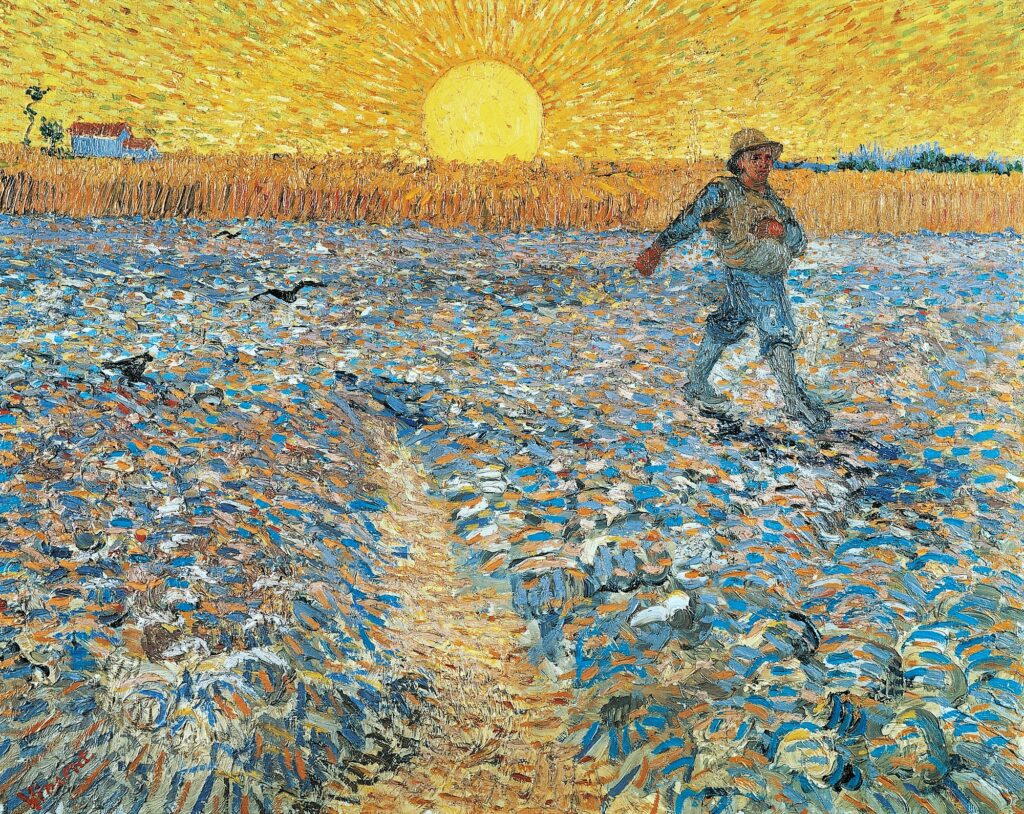
The parable that Jesus uses in the gospel this morning is similar in its use of natural imagery, but it reaches both farther and deeper than the passage in Isaiah. So many traditional commentators on this parable of the sower and the seed interpret it as a way of Jesus saying, live a good life and you will reap your reward. Sometimes even, invest your money and you will make more money. But the seed Jesus is talking about here is the Word, and what happens to that word depends on us. It depends on active listening – listening with the heart of our hearts and then responding to the Word. It’s about obedience and discernment. Listening and responding IS what obedience is all about.
Both the Isaiah passage and the parable of Jesus offer fruitful ground for lectio divina. Can we listen to the Word that Jesus sows in our hearts? Can we listen with the ear of our hearts? Can we discern what God is calling us to be and do?
This is a challenge for all of us whenever we read or hear scripture. Most artists who image this parable picture an actual sower, with their bag of seeds, and I could bet you a dollar to a Timbit that every church bulletin in Toronto will have a sower on the cover this Sunday. But this parable is not really focussed on the sower, it is about us who receive the seed – God’s Word – and what we do with it. The best image for this parable is not a sower, but a person sitting in silence in God’s creation, listening intently to the song of birds, the bubbling of a stream, the chirping of crickets, the buzz of a bee, the scurrying of little creatures in the grass, the wind in the trees – all the sounds of nature. What does the word of creation speak to us?
Or a group of people talking together, maybe even arguing, but listening intently to what is not said as much as to what is said, to discern God’s desire for them together.
What might be an image for you? Isaiah uses the image of rain watering the earth. Jesus uses the image of seeds growing. For us to listen and respond is to be obedient to God’s desire of us and our world, our universe in a time when no one is paying any attention at all to the Creator.
We need wisdom desperately in our time. We need the rain which comes down to water the earth. We need the seed sown as the Word of God. The Anglican poet Malcolm Guite speaks in many more images about the importance of the creating and recreating Word. Listen to him with the ear of your heart in this poem called O Sapientia, or Wisdom:
I cannot think unless I have been thought,
Nor can I speak unless I have been spoken.
I cannot teach except as I am taught,
Or break the bread except as I am broken.
O Mind behind the mind through which I seek,
O Light within the light by which I see,
O Word beneath the words with which I speak,
O founding, unfound Wisdom, finding me,
O sounding Song whose depth is sounding me,
O Memory of time, reminding me,
My Ground of Being, always grounding me,
My Maker’s Bounding Line, defining me,
Come, hidden Wisdom, come with all you bring,
Come to me now, disguised as everything.