By The Right Reverend Dr. Susan J.A. Bell
Ooh Sisters, (and Brother – and kidlets) today is not an easy feast.
Dare I say, that if we were designing the Church calendar ourselves, we might be tempted to leave this one out — and we would probably add a good many more women while we were at it, though that is a homily for another day.
There are no lilies here, no angels, no triumphant alleluias. Instead, we are given a prison cell, a rash promise, political cowardice, a grieving community, and the silence that follows a prophet’s death.
It’s actually a hard story to hear. And perhaps that is exactly why the Church insists that we hear it — because the Christian life has never been measured by comfort. It has always been measured by faithfulness.
In our reading from the Letter to the Hebrews, the author offers us a sweeping gallery of the faithful: the hall of fame of notable persons in scripture. Some conquered kingdoms. Some administered justice. Some escaped the sword.
And then, almost without warning, the mood turns: others were tortured, mocked, imprisoned; some wandered in deserts and mountains; the line about being sawed in half got me.
The point is driven home that all of these died without ever seeing God’s promises fulfilled. Of these the writer says this one striking thing — the world was not worthy of them. Not because they were powerful, or because they won; not because history remembered to applaud.
Only because they remained faithful.
Scripture just keeps reminding us that faithfulness and success are not the same thing. It’s not that you can’t be faithful and successful – just that they’re not the same thing.
John the Baptist knew this in his bones. His ministry was never about himself; from the very beginning he pointed away from his own importance and toward Christ. He must increase, but I must decrease. John never confused popularity with truth, and he never mistook influence for faithfulness. So, when Herod broke God’s law and abused his power, John spoke the truth plainly — and because it was true, it was also dangerous. That truth cost him first his freedom, then his life.
Mark tells the story with almost unbearable restraint. Herod is fascinated by John. He knows John is righteous. He even likes listening to him. But when the decisive moment comes, he chooses public approval over moral courage. It is, at its heart, a story about the terrible consequences of fear — fear of embarrassment, fear of losing status, fear of disappointing the wrong people. How contemporary that feels. How very now.
Our own age knows something about fear and the limits it pushes you to. People are anxious about the future. Wars seem like they may be endless. Communities grow more polarized. Economic uncertainty presses on families. Loneliness has become one of the defining marks of our culture. Even the Church wonders, some days, what the future holds.
It would be easy to believe these are unprecedented times. But Scripture has just gently reminded us otherwise: God’s people have always lived through uncertainty. The saints of Hebrews lived through it. John lived through it. The psalmist lived through it.
In you, O Lord, have I taken refuge. That’s interesting, the psalmist doesn’t say: “in you I have found certainty.” Or “in you every problem has disappeared.” Refuge. The difference matters enormously, because faith doesn’t remove the storm — it gives us somewhere to stand within it.
The psalmist also says, you have taught me since I was young, and to this day I tell of your wonderful works. That line moves me. It reminds us that faith is not simply the holding of certain beliefs; faith is remembering — remembering where God has already met us, that God has been faithful before, and that the Church has weathered storms before.
Some of you may know the old sermon preached sometime in the 50’s by S.M. Lockridge, the great Black Baptist preacher. There’s a recording of it on YouTube if you’re inclined to look it up and listen. Now I could never do justice to his southern cadence, but the message is one I carry with me. It is, at its heart, a sermon about memory — about Christians remembering God’s promises – remembering that resurrection has always followed Good Friday. I love to listen to him preach this. Because he says stuff like this:
“It’s Friday. Jesus is praying. Peter’s a-sleeping. Judas is betraying.”
“It’s Friday. The disciples are questioning what has happened to their King… but they don’t know it’s only Friday, Sunday’s comin’.”
“It’s Friday. Hope is lost. Death has won. Sin has conquered. And Satan’s just a-laughin’… but Sunday’s comin’.”
It’s Friday.
Jesus is buried.
A soldier stands guard.
And a rock is rolled into place.
But it’s Friday. It is only Friday.
Sunday is a comin’!
By S.M. Lockridge—African American pastor from 1953–1993
You know, the older I get, the more I believe that remembering is one of the holiest practices we have. Every community carries stories worth remembering: the moment someone stepped forward with unexpected generosity, the moment grief turned into compassion, the moment people chose hope over fear, the moment God quietly surprised everyone for all time. These stories become our inheritance. They teach us how to live faithfully when certainty disappears.
John’s disciples teach us something beautiful, too. After his death, they came and took his body and laid it in a tomb. It is such a simple sentence, and such a faithful one. They honoured their teacher. They cared for one another. They refused to let violence have the last word. Sometimes that is exactly what discipleship looks like — putting one foot in front of the other, keeping calm, carrying on. Not solving everything or fixing the whole world. Simply asking, what is the next faithful thing Christ is asking of me today, because our security rests in Christ and nowhere else.
Perhaps the next faithful thing we’re asked to do is speaking truth with gentleness. Perhaps it is offering forgiveness, or refusing cynicism, or praying when words fail. Perhaps it is continuing to love a community that feels fragile, or welcoming someone who believes they no longer belong. The Kingdom of God is so often built in ordinary acts of courage like these.
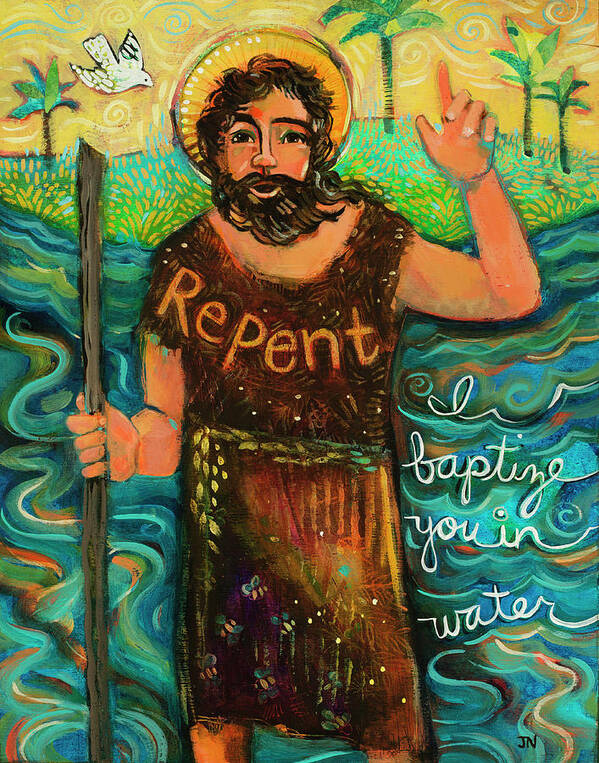
John’s witness didn’t end with his death — if anything, it became clearer. His life proclaimed that some truths are worth living for, and therefore worth dying for. And that’s not because suffering itself is holy, but because love is, truth is, because Christ is.
And that is precisely where Hebrews leaves us: God had provided something better. The writer points beyond every prophet, every martyr, every faithful disciple, toward Jesus himself. John’s story prepares us for Jesus. Like John, Jesus will be arrested by political power. Like John, he will stand before a hesitant ruler. Like John, he will be executed though innocent. But unlike John’s story, Christ’s doesn’t end at the tomb. Resurrection changes everything. It doesn’t erase suffering — it transforms it and it doesn’t deny death — it robs death of the final word.
So, I think John’s story reminds us that whenever we wonder whether faithfulness still matters in difficult days, we need only look to the risen Christ. Every act of mercy matters. Every courageous word matters. Every prayer, every act of justice, every choice to love instead of fear — none of it is lost in the Kingdom of God.
The Church has never been called to guarantee outcomes. We have only ever been called to bear faithful witness. Like the psalmist, may our mouths tell of God’s saving acts. Like the saints in Hebrews, may we persevere even when the promises seem distant. Like John the Baptist, may we point beyond ourselves to Jesus. And like Jesus, may we trust that love is stronger than death, hope stronger than fear, and that God’s future is already breaking into our present.
In the name of God: Father, Son, and Holy Spirit. Amen.