Celebrating the Conclusion of Women at a Crossroads 2026
By Sr. Constance Joanna, SSJD
The readings this morning seem as though they were chosen specifically for the Women at a Crossroads. They all speak of discernment, of how we learn the path God is calling us on and how our seeking is supported by the Spirit of God in our prayer.
Solomon is still a very young man when his father David dies, but he is mature enough, and learned enough in the scriptures as they exited at that time, to know the question he needed to ask of God. The scripture records God’s response:
It pleased the Lord that Solomon had asked [for a wise and discerning heart]. God said to him, “Because you have asked this, and have not asked for yourself long life or riches, or for the life of your enemies, but have asked for yourself understanding to discern what is right, I now do according to your word. Indeed I give you a wise and discerning mind; no one like you has been before you and no one like you shall arise after you.”
I believe that is the prayer with which each of you came on this program this summer. Solomon was at a Crossroads; each of you came at a Crossroads. Solomon had a discernment question; each of you came with a discernment question. God responded to Solomon not by showing him the ultimate path of his life, but with the gift of exactly what Solomon asked – for a wise and discerning heart.
And like Solomon, none of you is leaving here with a clear vision of the rest of your life’s path, but each of you is leaving with the tools of discernment and wisdom, and at least a hint of the next steps you need to take. But taking next steps is not easy. Prayer is not easy. Even knowing what to pray for is not easy. In the passage from Paul’s Letter to the Romans, we are given assurance that the Spirit accompanies us in our prayer and on our path. God asking Solomon, what is your desire – what do you long for, what do you need – is a foreshadowing of Paul’s assurance of the Spirit’s presence and power with us even when we don’t know what our deepest desire or need is.
The Spirit helps us in our weakness; for we do not know how to pray as we ought, but that very Spirit intercedes with sighs too deep for words. And God, who searches the heart, knows what is the mind of the Spirit, because the Spirit intercedes for the saints according to the will of God. (Romans 8.26-28)
If we desire discernment and wisdom above all, we will find the path God desires for us – because God’s desire is reflected in our own desire. The Spirit lives within us. In fact, in another part of Matthew’s gospel Jesus reminds us, “The Kingdom of God is within you.” In discerning our own deepest desire, we will also touch God’s own desire for us.
The thirteenth chapter of Matthew’s gospel is full of parables which reveal that truth. They are referred to as the parables of the Kingdom, because they are all about where we are going – what is the kingdom of God, how it grows, and what is our role in helping to build it.
They show us that no matter what decisions we have made in our lives, good and bad, noble and ignoble, if we desire wisdom and discernment rather than riches and power, the Spirit of God will lead us on, until ultimately we discover that God uses us for the divine purpose, to share our light with others, to help others know of the loving God we serve.
Jesus teaches this truth of the Kingdom by using common everyday objects and situations, In the section of the gospel chosen for today, Jesus uses five different images to show us what the kingdom is like, and what our role is in God’s plan.
First a mustard seed – the tiniest seed that grows into a great tree. The birds make their nests there. What a wonderful image of holy hospitality, shelter and nourishment. The smallest things we can do will have a large impact on the lives of many people
Next, yeast – a little leavens the whole lot of flour. Our love grows and helps to bring about God’s purpose just like the tiniest mustard seed.
The third ordinary object Jesus uses in these parables is treasure hidden in the field – when we find unexpected treasure, we will give up everything else to attain it. But there is more to it than that. “Buried in the earth” is often a Biblical metaphor for the womb, as in Psalm 139. So this treasure hidden in a field speaks to me of the way God regards each of us as a treasure from the moment of our conception. Each of us is precious, infinitely valuable. So much so that Jesus gives his life in order to unearth – literally – the possibility of full, abundant life for all.
Fourth, and maybe most famously, the pearl of great price. This sounds a lot like the treasure hidden in the field, but that involved an accidental discovery. In the parable of the pearl, a merchant is intentionally going out looking for the most precious pearls. It is not just finding treasure – it is the intentionality of the search, the willingness to persevere until we find that thing that God most desires for us, until we become the people God has desired for us since we were hidden in the depths of the earth.
After those four wonderfully inspiring images, Jesus comes to a more ambiguous one. The kingdom of heaven is like a net full of good fish and bad fish, and the bad fish are thrown out. I have to say, though, that the fate of the good fish might not be much better, because they are going to be cooked and eaten. But this parable too is about discernment, and how we know the difference between good and bad.
And finally, Jesus uses another image of discernment: “every scribe who has been trained for the kingdom of heaven is like the master of a household who brings out of his treasure what is new and what is old.” The scribe trained for the kingdom of heaven is a disciple trained in discernment – to know what to bring out of the storehouse – what is helpful and what is not, what tieds us down and what moves us along God’s path, what builds up the kingdom and what tears it down – and all of this whether old or new truths.
However you interpret these parables, Jesus reminds us throughout the gospels that evil is real, and the political wars around the world today are evidence that evil is alive and well in our world, and we need to be constantly vigilant, constantly discerning.
Even the parable of the pearl has a dark side, and there have been a number of poems that deal with this, from the early years of the Christian era to the twentieth-century novelist John Steinbeck who wrote a novel called The Pearl about post-war America in the 1940’s. It shows us how an image of beauty can be just as ambivalent as the fish caught in the net.
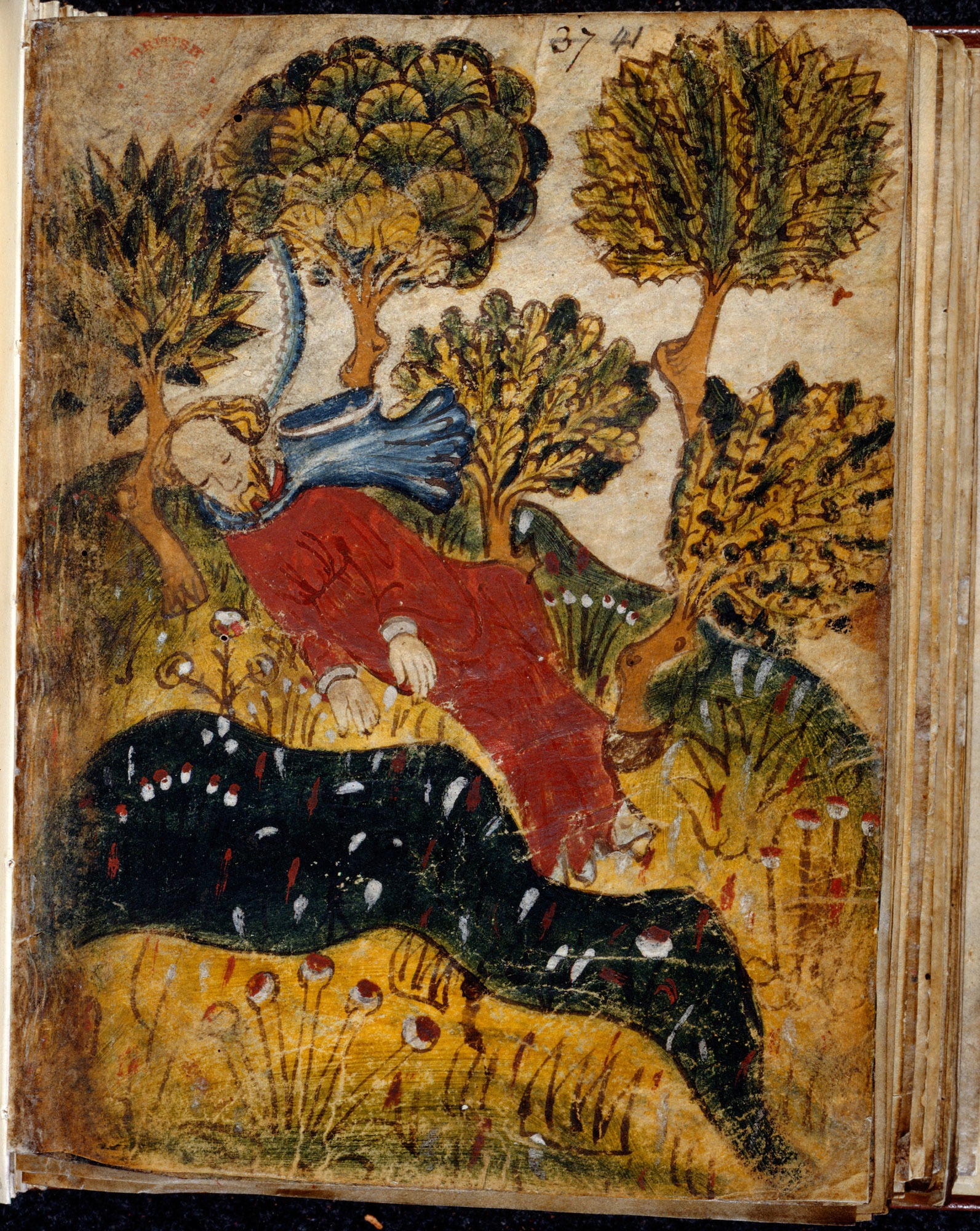
In the Anglo-Saxon poem of the 14th century, The Pearl, a jeweler loses a “pearl of great value” in his garden, and he suffers greatly in his grief. Ultimately, he falls asleep and in a dream vision he is educated by a beautiful woman (not unlike Dante’s Beatrice) to understand that the real pearl of great value is not the physical jewel he has lost, but his soul which longs for union with God. The evil of losing the pearl in fact becomes the good which he found – which is an understanding of the value which God places on human life, as we all become pearls in God’s eyes, a part of God’s necklace if you will.
The same idea is reflected in the reading from Romans:
We know that all things work together for good for those who love God, who are called according to his purpose . . . for I am convinced that neither death, nor life, nor angels, nor rulers, nor things present, nor things to come, nor powers, nor height, nor depth, nor anything else in all creation, will be able to separate us from the love of God in Christ Jesus our Lord.
The five parables or images of the kingdom remind us that God uses everything – even our greed and our grief, our deceptions and our losses – to bring about the divine purpose, ultimately to bring us to Godself, to help us know we don’t need to seek for pearls because the pearl of great price is hidden in our hearts, hidden “in the depths of the earth.”
Perhaps the most important thing any of us can learn in life, the thing that all our wisdom and discernment lead to, is how infinitely valuable we are to God. The pearl within us is that deep, insatiable longing for the source of life and love that gave us birth and that receives us into the arms of love when we die. I leave you with this ending from that 14th-century poem, The Pearl:
And afterward to God I gave up [the pearl]
In the dear blessing and memory of Christ,
Whom, in the form of bread and wine,
The priest shows to us every day.
He gave us to be His servants dear
And unto His pleasure precious pearls. Amen
May God bless each of you, nine precious pearls, as you receive the gift of Christ’s body and blood and continue to follow his leading in your lives.